This article originally appeared at Your Local Epidemiologist New York. Sign up for the YLE NY newsletter here. Public health, explained: Sign up to receive Healthbeat’s free New York City newsletter here.
How beautiful was New York this weekend with the snow?! I hope you all enjoyed it, stayed warm, and didn’t have any slips (I had to catch myself a couple times on ice.)

As we head into the holidays and many of us travel to be with loved ones, there’s some health news to keep in mind. This week, I’m covering a recall of mixed nuts, measles in Connecticut, health violations at medspas, and circulating respiratory viruses before YLE slows down for a holiday break. As always, drop us any comments on what you’re interested in hearing more about.
Let’s jump in.
Salmonella and Wegmans mixed nuts recall
Time for a pantry check: Wegmans grocery store is recalling two mixed nuts products for potential Salmonella contamination, sold in New York and eight other states and Washington, D.C. Products were sold between Nov. 3 and Dec. 1. No illnesses have been reported so far.
Products recalled:
- Wegmans Deluxe Unsalted Mixed Nuts 34-oz. tub, Family Pack
- UPC 077890421314
- Lot 58041
- Best by Jul. 28, 2026
- Wegmans Deluxe Unsalted Mixed Nuts 11.5-oz. bag
- UPC 077890421352
- Lot 58171
- Best by Aug. 10, 2026
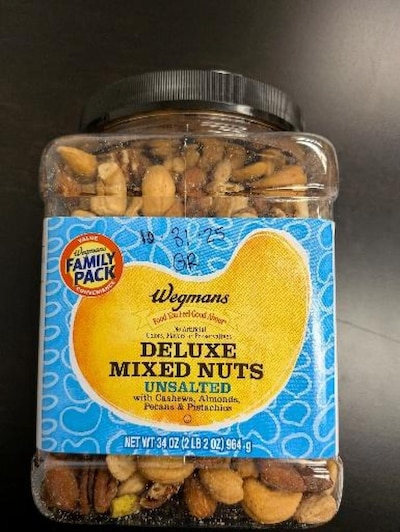
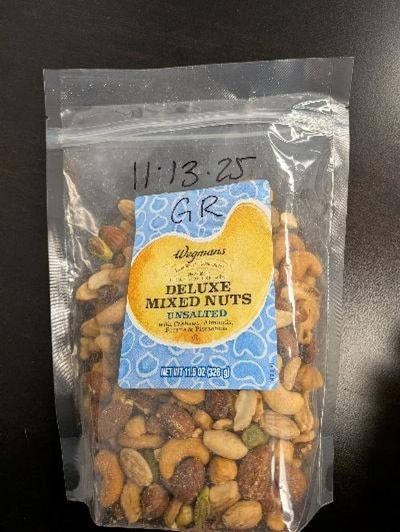
Routine testing by the supplier found one lot of raw pistachios to be positive for salmonella. The company then initiated a recall after determining these pistachios had been further used in the production of the Deluxe Mixed Nuts products.
What to do:
- Don’t eat them. Return for a refund or discard them.
- If you ate them and get fever, diarrhea, vomiting, or belly pain, most people can recover at home. But call your clinician sooner if you’re pregnant, over age 65, immunocompromised, or if your symptoms are severe/dehydrating.
Medspas are everywhere. Here’s how to check if yours is legit
Medical spas (or “medspas”) — those day spa-like clinics offering beauty services — are popping up everywhere. While they might feel like day spas, offering services like manicures or facials, many of their other procedures — Botox, fillers, IV drips, etc. — require providers to have a medical license. So before you visit one for a holiday season facial or a new treatment, it’s a good idea to make sure you know what you’re getting into.
A recent investigation into 15 New York City medpas (all of which had been flagged by consumers or agency staff as potentially problematic) found several health and safety violations, many of which could put customers and employees at risk.
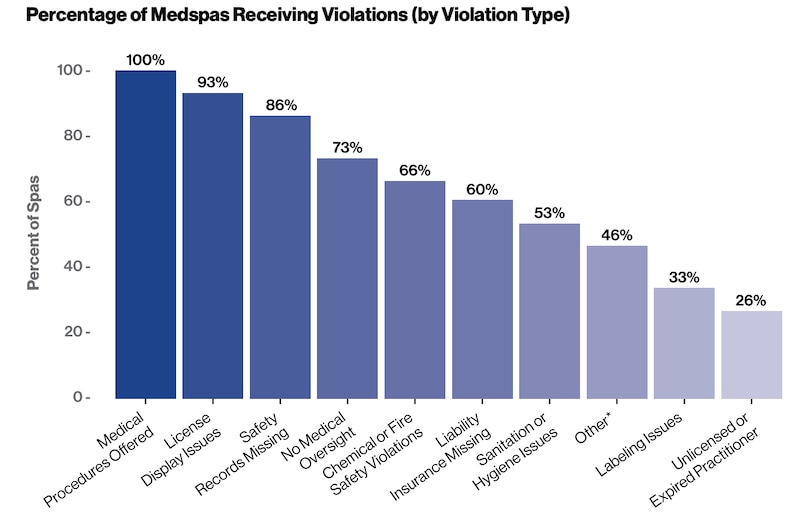
If you plan to visit a medspa, there are a couple of steps you can take to make sure standards are being met:
- If you are getting something that qualifies as a medical procedure (a rule of thumb is anything that breaks the skin or goes inside your body), check that your provider has a valid license. You can verify it through New York’s official database. Medical procedures must be performed by a licensed medical professional — like an MD, DO, PA, or RN — and in a licensed medical setting. It’s the law. All 15 of the investigated medspas were offering medical procedures without proper licensing.
- Check the business’s license. An “Appearance Enhancement Business” license covers cosmetology-type services (like facials, manicures, and hair salon services), but it does not cover injectables or other more invasive medical services, such as Botox, IV drips, or liposuction.
- Look for medical “green flags”:
- A real medical intake (history, meds, allergies), informed consent, and a plan for complications.
- Clear labeling and unopened product (especially for injectables).
- Clean room setup (hand hygiene, sharps container, sterile supplies).
Over half of the investigated medspas had serious sanitation and hygiene issues; some offered foreign or unregulated medications, and others used expired or potentially fraudulent products.
- Report concerns. To file a complaint against a medical practitioner in New York, you can contact the New York State Department of Health’s Office of Professional Medical Conduct for doctors/PAs or the New York State Education Department’s Office of Professional Discipline for other professionals (licensed or unlicensed).
Measles in Connecticut (and what it means for New York)
Connecticut just confirmed its first measles case in more than four years in an unvaccinated child under 10 in Fairfield County. The child had recently traveled internationally with family. Contact tracing by the health department is underway, and people who may have been exposed are being notified. The health department said unvaccinated or under-vaccinated (with fewer than two doses of MMR) children and adults, including those with vaccination exemptions, will need to be out of school for 21 days.
Measles is one of the most contagious viruses — it can linger in the air for up to two hours after an infected person leaves a room, and 9 out of 10 unvaccinated people exposed will get infected. It also isn’t “just a rash” and can cause severe illness: In children under 5 years old, 1 in 5 cases are hospitalized. In severe cases, measles can cause pneumonia and brain swelling.
What to do (in Connecticut, New York, and anywhere else):
- Check MMR status for everyone in your household. Two doses are about 97% effective at preventing measles.
- If you think you or your child were exposed and develop symptoms, call your doctor/urgent care. Make sure to call before showing up in person so that proper precautions can be taken to avoid exposing others.
- Watch for symptoms: fever/cough/runny nose/red eyes, then rash that often starts at the hairline and moves downward.
It’s not too late to get vaccinated, especially if you will be traveling internationally or to any U.S. region with a measles outbreak.
The recommendation is:
- Being fully vaccinated with the MMR vaccine at least two weeks before departure.
- If the trip is less than two weeks away and the traveler is not immunized, getting one dose of MMR is advised.
As always, consult with your medical provider to discuss what’s right for you and your family.
Infectious disease ‘weather report’
Flu: Increasing sharply. The most recent data show that cases and hospitalizations in the state have increased by 29% and 75%, respectively. Emergency department visits and hospitalizations for the flu in New York City are also rising, with the largest increases among kids under 18.
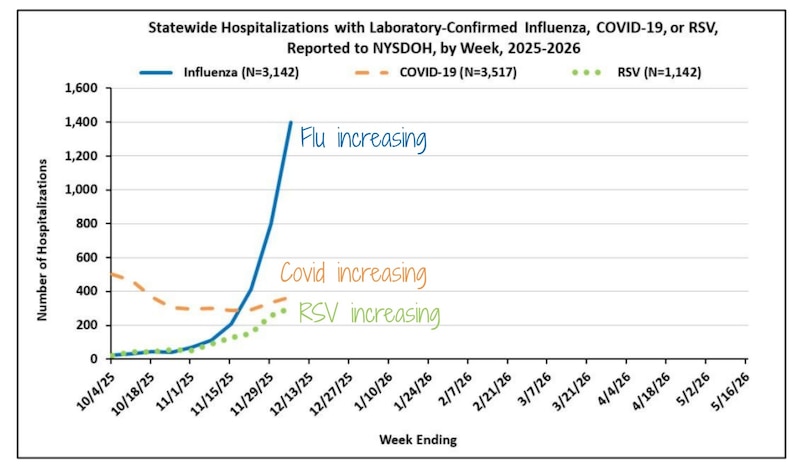
RSV: Also increasing across the state, mostly in kids under age 4. Statewide, hospitalizations increased by 18%.
Covid: Slowly increasing in New York.
As we head into the holidays, when many of us will be traveling to see loved ones, flu is top of mind. To reduce the spread of illness, consider masking in indoor crowded spaces — I’ve been wearing mine on the train, in the airport, and at grocery stores — and reducing contact with others if you’re feeling sick.
Bottom line
You’re all caught up on New York public health news! I hope the holidays bring you peace, joy, rest, and all the cookies.
Love,
Your NY Epi
Dr. Marisa Donnelly, PhD, is an epidemiologist, science communicator, and public health advocate. She specializes in infectious diseases, outbreak response, and emerging health threats. She has led multiple outbreak investigations at the California Department of Public Health and served as an Epidemic Intelligence Service Officer at the Centers for Disease Control and Prevention. Donnelly is also an epidemiologist at Biobot Analytics, where she works at the forefront of wastewater-based disease surveillance.