This article originally appeared at Your Local Epidemiologist New York. Sign up for the YLE NY newsletter here. Public health, explained: Sign up to receive Healthbeat’s free New York City newsletter here.
There’s a lot happening in New York health right now — from universal child care plans and the New York City nurses’ strike to rising health care premiums and continued flu. Let’s jump right in.

Hochul and Mamdani announce a plan for universal child care in New York
Last week, Mayor Zohran Mamdani and Gov. Kathy Hochul announced a joint plan to bring truly universal child care to New York City and extend it across the state.
Why this matters
Access to high-quality child care has been shown to benefit children’s and parents’ health and well-being:
- High-quality early care and education programs are associated with positive developmental outcomes for children, including early learning, cognitive and language development, stronger school readiness, and emotional skills.
- Child care has been associated with improved maternal mental health, including protection against symptoms of depression, by reducing stress and caregiving burden on parents.
- Expanded access has also been shown to increase maternal employment and economic stability — important components of health equity. One assessment found that mothers’ labor force participation in New York City increased by 7.5% after universal pre-K for 4-year-olds was implemented.
It’s important to note that the quality of the care is what’s most important, not necessarily where the care takes place. High-quality care and education can take place at child care centers or inside the home, and with community-based caretakers or family members.
What’s the plan?
The joint plan to expand child care in New York City and the rest of the state is mostly driven by funding additional child care facilities and increasing staffing levels.
In New York City, the additional funding would help make 3k (child care for 3-year-olds) access truly universal. Right now, many families qualify for 3k but don’t have spots available in their neighborhoods, requiring them to commute unfeasible distances or find/pay for other child care. The funding would increase facilities and staffing in New York City.
The proposal would also launch a new “2-Care” program in the city, providing free child care for 2,000 2-year-olds in high-need areas beginning this year. The program would then be expanded citywide over four years, with the state fully funding it for the first two.
The state’s goals are to expand child care to all 4-year-olds (also called pre-k) statewide by fall 2028, and help counties build pilot programs to offer affordable child care. Hochul said the broader statewide plan would increase affordable child care to nearly 100,000 additional children through a mix of universal pre-K expansion, new community-based care programs, and broader eligibility for child care subsidies.
The plan also includes:
- Increasing state funding for pre-k seats to at least $10,000 per child
- Expanding child care subsidies, with most eligible families paying no more than $15 per week
- Raising income eligibility to about $114,000 for a family of four
How will it be funded?
The governor has committed a $1.7 billion investment to expand child care across the state. If the legislature approves the budget, total child care and pre-k funding will be $4.5 billion for fiscal year 2027. The current proposal uses funds that already exist and would not currently require increased taxes. However, a plan for long-term funding of the expansion has not been proposed.
What happens next?
To accomplish the goals of universal child care in New York, there are a couple of big milestones ahead:
- The state legislature still needs to approve Hochul’s funding requests, although the strategy of using existing state funds rather than raising taxes makes it more likely to go through.
- The child care workforce will then need rapid growth, including hiring and training teachers, and improving the infrastructure of the current fragmented system of schools, day care centers, and private home caregivers.
- The plan will also need long-term funding. If the program is successful, will taxpayers and lawmakers be willing to sustain its funding? Additionally, how will changes in federal funding affect New York programs? ($10 billion in federal funding for child care subsidies is currently frozen, including in New York, and being debated in the courts.)
Making child care truly universal in New York has great potential to improve the health of children and parents. I’ll be watching its progress closely and reporting back.
~140,000 New Yorkers now face higher health care costs
Remember the 43-day government shutdown in the fall? (Feels like years ago already, I know …) One of the issues at the center of the debate was whether to extend health insurance subsidies under the Affordable Care Act. While the government eventually reopened, Congress never reached an agreement, so the enhanced subsidies expired on Dec. 31.
Now, 140,000 New Yorkers, and millions of Americans across the country, are seeing their health insurance costs substantially increase.
I did a deep dive on ACA subsidies in November, but here’s a quick refresher:
Under the ACA, coverage in New York is tiered based on income, anchored to the Federal Poverty Level. Before 2021, anyone making just $1 over 400% of the FPL — roughly $60,000 for an individual or $124,000 for a family of four — got zero financial help through the ACA. This was called the “subsidy cliff.” It disproportionately affected those who don’t get insurance from an employer and don’t qualify for Medicaid or Medicare. This includes many self-employed or freelance workers, small business owners, farmers, and early retirees, among others.
In 2021, the pandemic relief package removed the subsidy cliff, allowing anyone to get financial help if their premiums were greater than 8.5% of their income. But when the ACA subsidies expired at the end of last year, the cliff came back.
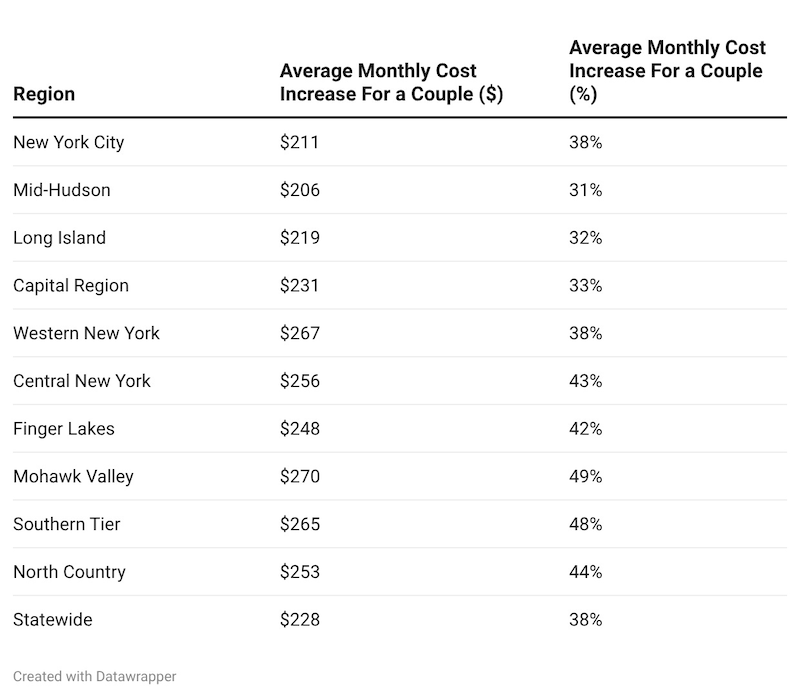
Hochul’s office estimates the average health care cost for a New York couple who previously qualified for ACA subsidies is now up 38%, meaning an additional $238 per month. That’s nearly $3,000 more per year for couples. It also varies across New York; Mohawk Valley has seen the steepest increase at 49%.
Despite the increases, there are some signals that Congress may be moving toward getting these subsidies back up. Earlier this month, the House passed a bill to reinstate and extend the ACA subsidies another three years; this moved to the Senate for consideration, where negotiations are ongoing. (A similar bill was voted down just last month.)
If you have questions about your New York coverage options, premiums, or eligibility, call 1-855-355-5777 or visit nystateofhealth.ny.gov. The deadline to enroll in a Qualified Health Plan (i.e., if you aren’t eligible for Medicaid, Medicare, the Essential Plan, or Child Health Plus) is Jan. 31.
I’ll also keep watching this and share updates as they come.
NYC nurses strike: What’s happening and what it means for you
This week, nearly 15,000 nurses across some of New York City’s major hospitals — Montefiore Medical Center, Mount Sinai Hospital, Mount Sinai West, Mount Sinai Morningside, and NewYork-Presbyterian — went on strike. This is the largest health care strike in New York City’s history.
Why are they striking?
The union is calling for:
- Legally enforceable nurse-to-patient staffing ratios, so that nurses aren’t overwhelmed with too many patients, increasing safe patient care.
- Higher wages to keep pace with inflation and retain staff amid worsening nursing shortages.
- Increased hospital security to reduce workplace violence, which has risen in New York City health care settings.
The hospitals have pushed back on the demands, stating they would cost billions of dollars over the next three years and that they can’t afford the increases in light of health care funding cuts from the One Big Beautiful Bill Act. They also say these funding issues will be exacerbated as more New Yorkers lose health insurance, resulting in more uncompensated medical care.
What this means for patients
The New York State Nurses Association is encouraging patients to continue seeking care at the hospitals. In preparation, hospitals have brought in travel nurses and temporary staff, and Hochul issued an executive order to temporarily suspend certain licensing and practice restrictions so that clinicians who are licensed and in good standing elsewhere can work in New York without penalties, allowing hospitals more flexibility to keep adequate staffing. Still, hospitals may resort to transferring patients to other hospitals if capacity is strained.
How long will it last?
The last major New York City nurse strike in 2022 lasted three days. This one is much larger with the potential to cause more disruption to hospital systems — the longer it continues, the more pressure hospitals may face to delay non-emergency procedures and divert incoming patients.
Why it matters
Staffing ratios are a public safety and health equity issue. Studies show that safe nurse staffing is linked to lower patient mortality, shorter hospital stays, and better health outcomes. A 2002 JAMA study showed that:
- Hospitals that staff 1:8 nurse-to-patient ratios experience five additional deaths per 1,000 patients than a 1:4 nurse-to-patient ratio.
- The odds of patient death increase by 7% for each additional patient the nurse must take on at one time.
Ensuring nurses have the time and bandwidth to adequately care for their patients is vital.
I’ll keep you updated if anything changes.
Infectious disease ‘weather report’
Flu: It looks like flu may have peaked in New York, but levels remain very high across the state and New York City. Even with recent declines over the past two weeks, we’re still at levels close to the peak of the 2023-24 season. In short: Flu is still widespread in New York.
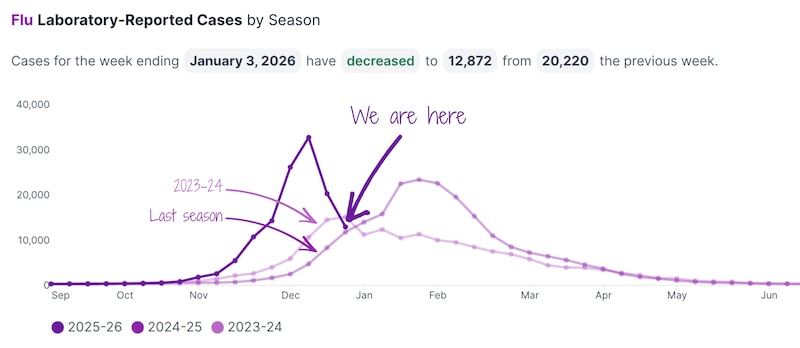
I wouldn’t be surprised if we saw flu pick up again — that happens in some seasons. Because flu will still circulate into February and March, it’s not too late to get your flu shot.
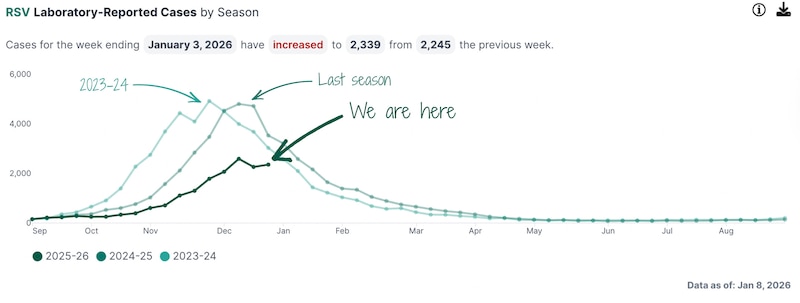
RSV: Remains high but may have plateaued. (I know I said that last week, but the data is holding.) The good news is that RSV this season is lower than in the past two years.
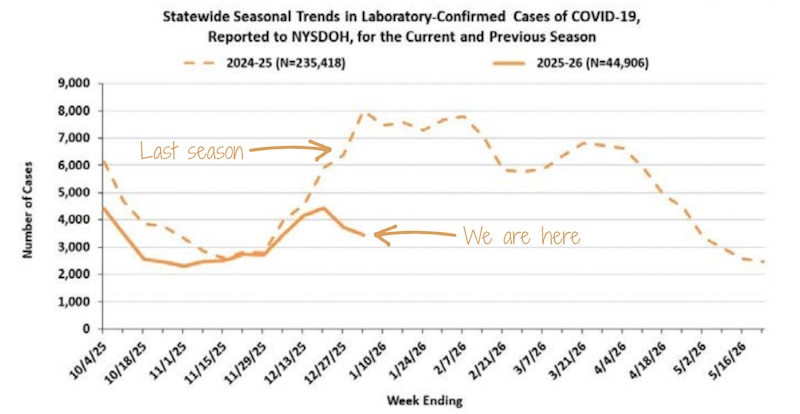
Covid: In good news, Covid is still low across the state. State case data show that it may have peaked, and at a lower level than the late-summer surge we saw earlier this year.
Bottom line
There’s a lot going on in the New York health policy world, with many evolving situations that I’ll keep a close eye on.
From an infectious disease standpoint, flu is still the biggest concern right now. Staying cautious, especially in crowded indoor settings, is still a smart move, particularly for those at higher risk (older adults, people who are immunocompromised, pregnant, etc.).
Love,
Your NY Epi
Dr. Marisa Donnelly, PhD, is an epidemiologist, science communicator, and public health advocate. She specializes in infectious diseases, outbreak response, and emerging health threats. She has led multiple outbreak investigations at the California Department of Public Health and served as an Epidemic Intelligence Service Officer at the Centers for Disease Control and Prevention. Donnelly is also an epidemiologist at Biobot Analytics, where she works at the forefront of wastewater-based disease surveillance.