This story was part of Healthbeat’s live storytelling event, “Aha Moments in Public Health,” held Nov. 3 at Manuel’s Tavern in Atlanta. Watch the full show here. Sign up to receive Healthbeat’s free Atlanta newsletter here.
Early in my career, I was a social worker in Manhattan, helping older adults navigate life’s challenges. I had studied social service administrative practice at school and wanted to make big systems work better for people. But to do this I knew I first needed to “live” inside one to understand it.
The walk-in center where I worked was a converted storefront — a cramped space with nine desks and little room for privacy, but full of purpose and always teeming with people. My desk was just 10 feet from the door, with the waiting area tucked in between, and spitting distance from the receptionist, who would put calls on hold and then call out as if we were fields apart, “You’ve got a call on line 3!”
Many of the people I served shared similar struggles: loneliness, fading social connections, and confusion with the systems meant to help them. It was a humble, imperfect place, but it taught me something important, especially at the start of my career. We had scarce resources, there were no frills (the bathroom door hit the bookkeeper’s desk every time!), and we were met with constant challenges. But every day we showed up to help people figure things out.
One day in October, a little over a year in, something happened. I emerged from the stifling heat of the subway and felt the crisp fall air snap into my lungs. As I walked with the familiar waking rhythm of the city swirling around me, I thought of fall in New England, when green leaves always gave way to brilliant reds and golds that were swept away by a gust of wind only to gently fall and settle as a waiting pile that would elicit shrieks of joy from bounding children. That cycle was and is still a simple, natural, and predictable one; one where each action yields another, and every aspect of life is connected.
That October morning, my mind drifting with the leaves, I turned the corner to my workplace and stopped short. There, perched on the stoop in front of me was James — head tucked, body curled in on itself, rocking slightly, and oozing sadness.
James had been coming to the center for about six months. He had lost his partner of 20 years to complications from AIDS, and though he came in first for help with a heating issue, he regularly returned with small but compounding needs — each one seeming too big to handle, too confusing to navigate, too much to deal with. With each visit, James talked, and I listened to his stories of love, loss, and grief. I could see he had a growing sadness that was pulling him down like quicksand, slow and deliberate in its lasting grip. I saw it happening, but I struggled with what to do to “fix” it.
When I saw him that morning, wound tight with despair, I ushered him inside and sat with him. He cried; I listened. When his sobs finally slowed, he began to speak. The words he whispered that day have stayed with me ever since:
James told me he had woken that morning in the stillness of his life and thought of suicide. He dressed and walked to the stairwell leading to his building’s roof and stood there, staring upward. He put his foot on the first step and thought: I can go up to the roof and jump, or I can go talk to Aliki.
There were mornings after that day when I would arrive at work wondering, Will today be the day James chooses the roof? I think often of the simple power of that lesson for me. It was when my job became my purpose. When I realized I would carry an enormity and an intimacy in service to others. When I realized that the smallest human connection could shift the course of a life.
Now, years later, after many more years in public health service, I reflect on that time — on the tiny office, scarce resources, and endless challenges — I am reminded that the most powerful system of all is not born from policy, or organizational design, or quick fixes. It is in the simple, natural, predictable actions.
It lives in the smallest moments, the listening without fixing, the quiet power to make a difference, one person at a time. It is the shared joy of jumping in a pile of leaves and shrieking with glee.
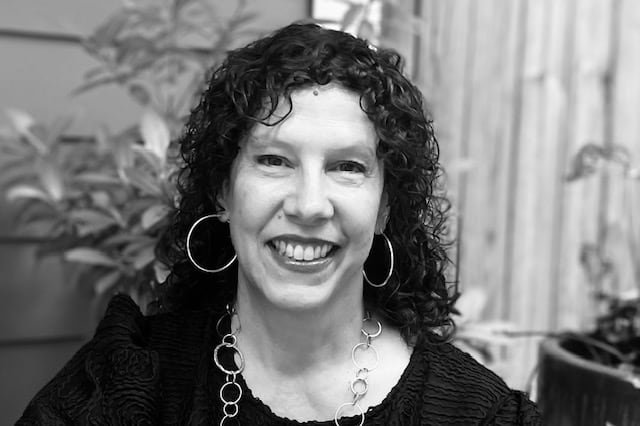
Aliki Pappas Weakland has over 25 years experience in social services and public health. She currently serves as an associate director in the Centers for Disease Control and Prevention’s Office of Readiness and Response. Among her degrees is an MPH from Emory University’s Rollins School of Public Health.