Public health, explained: Sign up to receive Healthbeat’s free New York City newsletter here.
Public health has long focused on the biology of pathogens — how viruses spread, how vaccines save lives, and how treatments can prevent disease — but Perry Halkitis believes the field should take a closer look at the role that humans play in public health.
Such is the focus of his new book: Humanizing Public Health: How Disease-Centered Approaches Have Failed Us.
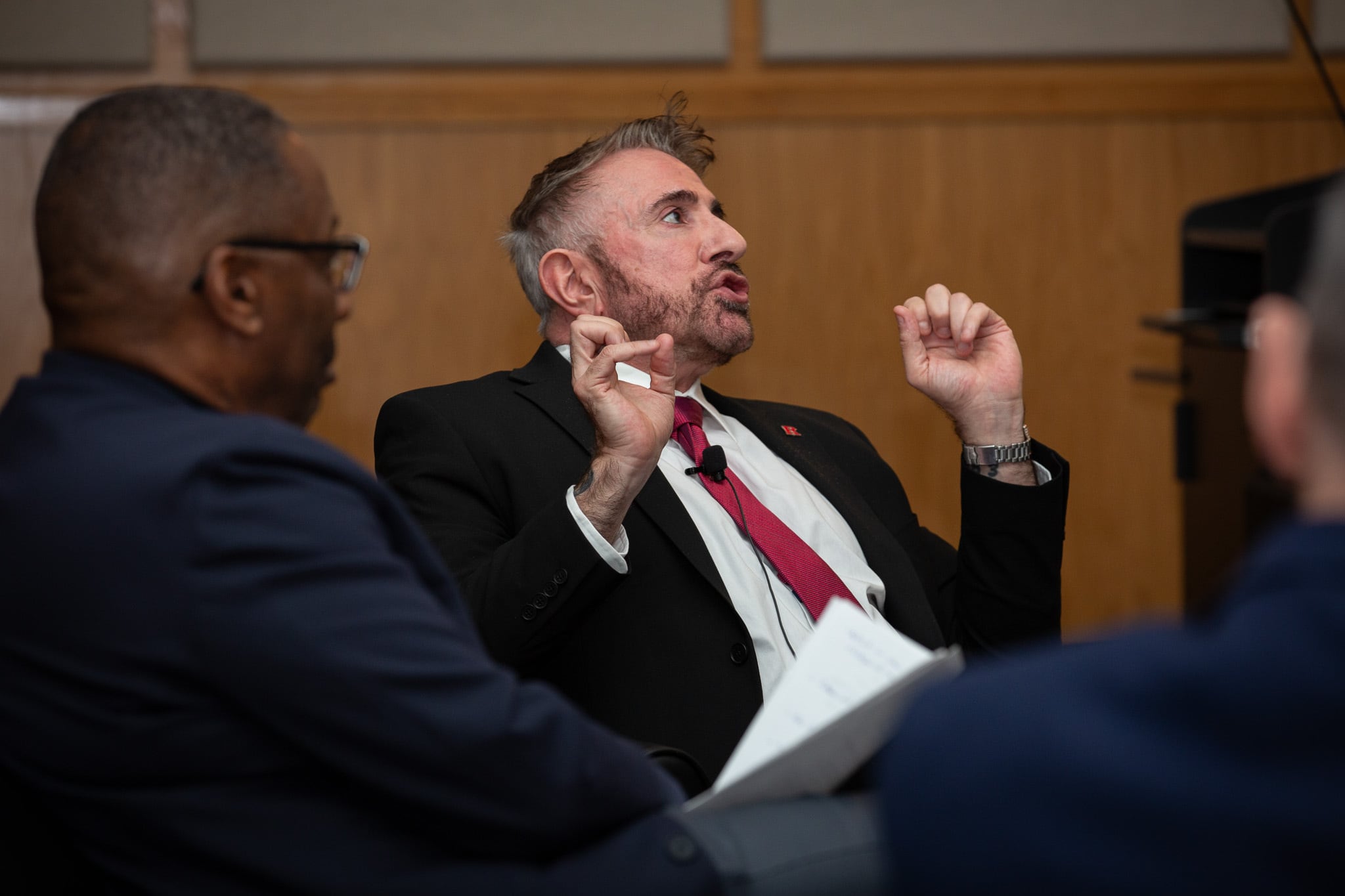
Halkitis has served as the dean of the Rutgers School of Public Health since 2017. Prior to that he worked as a professor at the Center for Health, Identity, Behavior and Prevention Studies at New York University; the center has since moved to Rutgers, which he still leads. Halkitis conducted research on HIV/AIDS, drug abuse, and mental health. He is also an epidemiologist, applied statistician, and public health psychologist.
His academic area of expertise is people who have been infected and affected by HIV — a topic he explored in an earlier book, The AIDS Generation. It may come as no surprise that Halkitis saw parallels between the AIDS epidemic and the Covid pandemic and felt compelled to write his latest book on the need for a public health sector that puts humans front and center.
In a conversation with Healthbeat, Halkitis, 63, a New York City native who lives in Manhattan, discussed how public health might “humanize” itself, how the LGBTQ community can serve as a model for tackling public health challenges, the importance of public health influencers, and the reality that five tequila shots might compromise our better judgment.
This interview has been edited and condensed for clarity and length.
Your new public health book has just come out. Can you tell us about it?
It talks about the need for us to understand public health with humans at the center of all diseases. It means that we have to show humanity to each other as members of communities, and it means that we have to attend to the human elements of disease, i.e. people’s emotions or psychological states, their identities — all the things that make people people — and stop treating people like they’re laboratory rats running around mazes.
The book interweaves a story around HIV and Covid, mpox, Ebola, and the 1918 flu — everything from the history of pandemics and diseases that shows that human beings are a problem, for lack of a better term.
Human beings make irrational decisions that seem rational to some of them. They make decisions based on what feels good.
I remember sitting in a room with a bunch of really prominent researchers, and I was just a new guy. They were talking about the model they were going to develop — the model was if we gave people confidence in using condoms, they would use condoms.
The little young Perry said, ‘not if they’ve had five tequila shots.’ That, for me, summarizes what this book is about, which is, yes, those models work if people are making decisions based on reason and logic.
Public health depends on those models, but people do not make decisions based on reason and logic, and therefore the models are tenuous at best. You need to create emotion-based models in order to change people’s behavior.
Ultimately, if you’re trying to enhance the people’s empathy and altruism, you have to show that there’s a benefit in there for them too.
Public health leaders are trying to get their messaging out, but they’re up against some powerful forces, the mighty algorithm being the latest. How can public health leaders push back against that?
There’s two answers to that question. If you go back and check on all the major networks that had been presenting information during Covid, it was mostly by medical doctors. It wasn’t public health people. That’s public health’s fault.
Number one: We should have demanded that they should have been talking to us, because we know how to talk to people. Number two: We need to be training our students how to use these tools to be able to be effective leaders.
Which means that we need to be engaging with social media companies, to have them come in and train our students just like we train students to do statistics, epidemiology, policy analysis and outbreak investigation. We need to teach them how to be able to message to the top communities that they work with through social media.
The simple answer is that we need to teach people to be public health influencers, and we’re not doing that. At Rutgers, we are trying to do that, we’re changing our curriculum to address this very issue, because our students are telling us, ‘I need these tools to become a public health influencer.’
Your ‘humanizing’ title also seems to be acknowledging that artificial intelligence is in the room, no?
You can bet you can use AI in effective ways to tailor messages. What’s going to work for a 70- year-old or a 50-year-old is going to be different from an 18-year-old. When I say ‘humanizing,’ I’d say use all the tools at your disposal, including industry, which includes AI. And develop those messages that are humanistic, or tell me how to say [certain things].
There’s a new administration in New York City, and public health is being broadly linked to an affordability agenda. What are your thoughts on that approach?
Affordability is a very, very, very, very important characteristic of health disparities, a very important driver of health disparities that we see in New York City. Case in point: If you look at the HIV map in New York City, you will see a lot of people infected in Chelsea, a lot of people infected in the south Bronx and central Brooklyn.
If you put it next to it a map of where people are dying of AIDS, they’re not going to see people dying in Chelsea. But they are dying in central Brooklyn and south Bronx. What’s that about? That’s about affordability and access. It’s about access to care. It’s about access to services, affordability of medications, affordability of good food, affordability to see the best doctors. I agree 100%.
Are there any public health issues in the city that keep you up at night, or that are overlooked?
Obviously homelessness, because we see it everywhere. People are sick. They’re on the street. During this hard winter we had, which was the first rough one in a long time, people were just out there.
What also keeps me up at night is the next viral outbreak. One of the things I write about in the book is you want a model of something that works really well in a population that comes together. Look at what happened in response to mpox. We got that under control.
I do worry about bird flu and a mutating H1N5. I worry about a new clade of mpox. I worry about measles outbreaks now, because [New Yorkers] are not just staying confined in the city.
Greater New York is going to see its share of visitors — more than a million, it’s expected — when the region hosts the World Cup. In light of the dramatic changes to the Centers for Disease Control and Prevention and the World Health Organization, which have traditionally been responsible for disease surveillance, what are your thoughts on how all these local agencies might be able to handle these duties?
I have every confidence that the city will stay on top of it. When people ask where to go for information right now, [I don’t send them] to the CDC site. It’s all garbage. [I send them to] the [New York State Department of Health], which is doing a really good job. It remains a reliable source and a vigilant organization that is very much on the pulse of what’s going on with health issues and is very good about communicating in effective ways about that.
New Jersey is okay, too. They have a pretty good health care system and a public health care system there.
It’s the rest of the country I’m worried about. We’re going to have to be even more on alert in the next few months than before.
Anything else you want to add?
The gay population can serve as a model of how a community comes together and cares for each other. That, to me, is about altruism and care and concern. Maybe it’s because we’re all traumatized for 45 years of AIDS. The thought of Covid, the thought of something else destroying our lives, [compels us to] rally. There is a lesson that hasn’t been played up enough.
This story was updated to clarify that the Center for Health, Identity, Behavior and Prevention Studies is at Rutgers.
Trenton Daniel is a reporter covering public health in New York for Healthbeat. Contact Trenton at tdaniel@healthbeat.org or on the messaging app Signal at trentondaniel.88.