Public health, explained: Sign up to receive Healthbeat’s free New York City newsletter here.
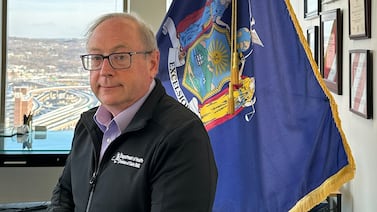
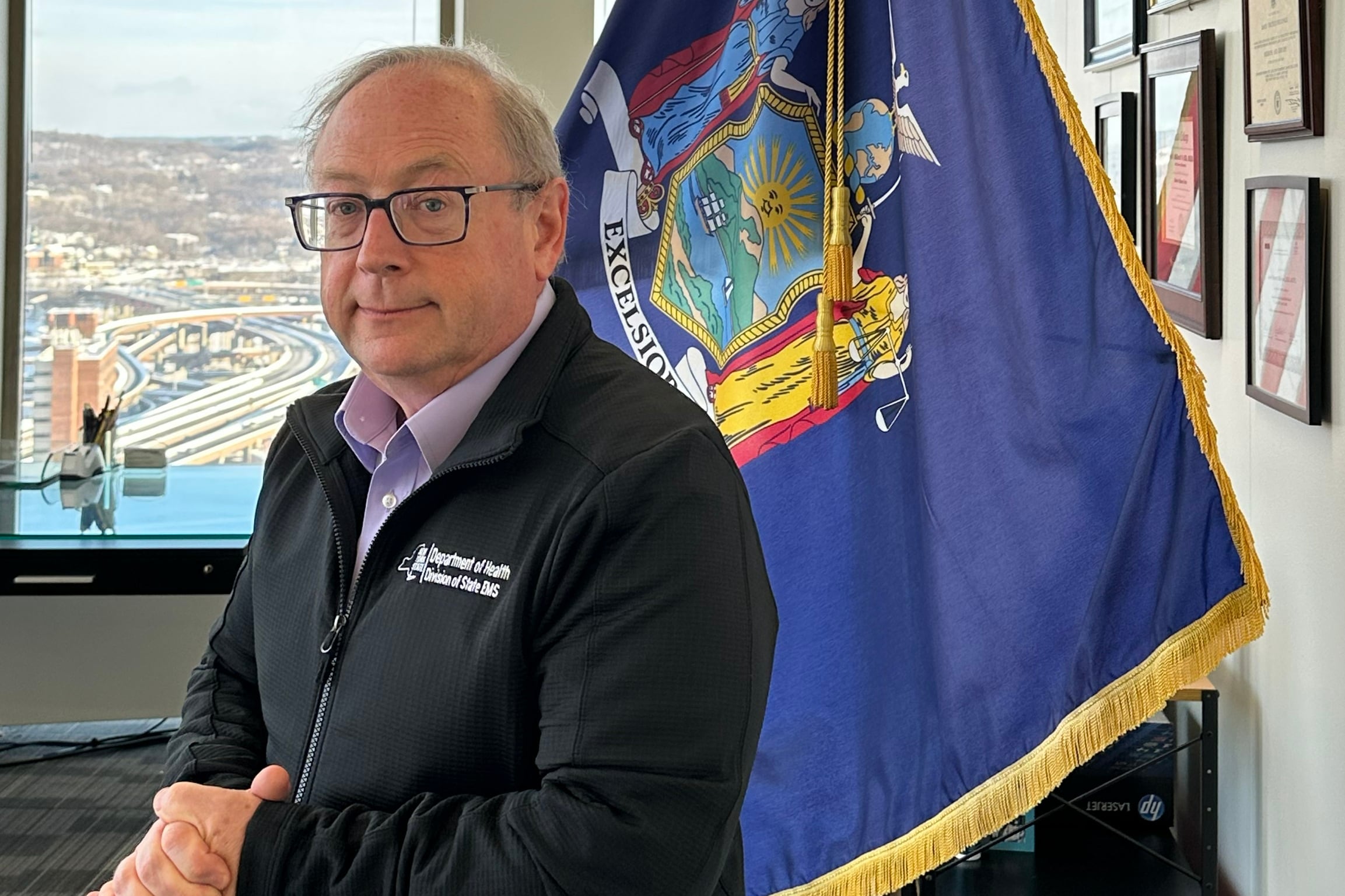
Dr. James McDonald is leading the New York State Department of Health at a tumultuous time for public health in America.
Disruptions to federal health funding, vaccine recommendations, and operations at the Centers for Disease Control and Prevention are creating new challenges for state public health systems.
As head of one of the nation’s largest state health departments, McDonald is tasked with leading the response to those challenges – keeping New Yorkers insured at the top of the list.
McDonald, 62, a pediatrician, joined the state health department in July 2022 and became commissioner on June 9, 2023. He has also served at the Rhode Island Department of Health and the Indian Health Service in the Navajo Nation in Chinle, Arizona.
This week, he sat down with Healthbeat for a conversation in his office at the Erastus Corning Tower in Albany, sharing his perspective on issues like looming cuts to Medicaid, a new public health alliance in the Northeast, how global health affects New York, and how the CDC is “forever changed” in this era he calls the “Great Desensitivation.”
Here’s the interview, which has been edited for clarity and brevity.
What are the top three public health health challenges facing New York this year? What keeps you up at night?
The biggest threat is the change in how the current [federal] administration is looking at insuring New Yorkers. I have worried a little bit about Medicaid coverage. Starting in 2027, when you look at the work requirement that’s part of H.R. 1, what they’re trying to do is get people off Medicaid. It’s based on a concept that people don’t need Medicaid. The reality of it is a lot of people on Medicaid already are working. They don’t make much money, and they need Medicaid because that’s their health insurance. That’s one of my biggest concerns for this year and next.
Although the federal health policy is they want to make America healthy again, the actions look more toward just promoting suffering. This should bother more people than it does on a national level.
— Dr. James McDonald, New York state health commissioner
One of my other big concerns is what’s happened to the Affordable Care Act. We’re addressing it as best we can. In 2024 we expanded our coverage to people up to 250% of the federal poverty level. Just to make that real, that’s like an individual making up to $39,000 a year. Those are working New Yorkers, and that’s changed. Now we have to change that to accommodate where the federal government is going.
The third concern I have is that as a country we are in a period that I’m going to call the Great Desensitization. We’re tolerating things that we never would have tolerated before. That encompasses things like hearing misinformation about vaccines, and people are confused by this. I was concerned about how the shutdown was handled. The government was comfortable with people losing food benefits, and the state of New York stepped in to protect our New Yorkers. What I see with people becoming uninsured is an overarching theme, and one of my concerns is, although the federal health policy is they want to make America healthy again, the actions look more toward just promoting suffering. This should bother more people than it does on a national level.
Let’s go back to one of the things you’ve just said: H.R.1.
What I’m concerned about is people who need health insurance won’t get health insurance. The challenge for any state is going to be, how do you apply the exceptions for people who can’t work, so you can actually keep them insured. One of the challenges states are going to have is we don’t have the rules and regulations yet that the federal government is going to use to enforce this. Those come into being by June 30. So that gives us till Dec. 31 — six months – to implement a very substantive change. We are doing our best to get ready for that, but without seeing the regulations, there’s only so much we can do.
What I’m concerned about is that you’re going to end up with people who aren’t going to get health care. Most of us would agree, generally, if you find cancer early, you get better outcomes, whether it’s breast cancer or colon cancer. But if you don’t have health insurance, you’re not going to have a mammogram, because you’re going to say, I’m not going to pay for that. That’s not something you go to the emergency department for. But if you don’t have health insurance, you’re not going to have a colonoscopy. If you don’t have a mammogram, we’re not going to find your breast cancer before it turns into cancer or the early stages. As annoying as a colonoscopy is, they’re really important to have. If you don’t have a colonoscopy, we’re not going to find that polyp that was precancerous and remove it.
We all learned growing up, an ounce of prevention is worth a pound of cure. I see the federal health policy being this smorgasbord of chaos and confusion.
Could the new CDC guidelines that seem to emphasize “choice” deter New Yorkers from getting vaccinated, and what is New York state doing to push back on this messaging and reach people who might need to hear these guidelines?
It’s important to know there was no new science presented; there was really no new information presented. This was implementing something that was really politically motivated.
No vaccine in New York or any state is given without informed consent. I’ve been a pediatrician for over 35 years. I’ve given over 100,000 vaccines easily in my career, and every single one of them has had informed consent. No one gets vaccines without consent, and shared clinical decision making is simply a risk-benefit conversation with your health care provider. That already happens.
What happened to the CDC schedule is it went from something that was easily understandable to something exceptionally confusing. I don’t think the impact in New York is going to be significant. New York’s vaccine requirements, which are mandated by New York state law, haven’t changed. I don’t think they’re going to change.
How might you be able to reach people who are skeptical of vaccines?
There’s no one way to solve that issue. We put forward honest, objective information. We go to different communities. We work with local leaders, we work with local health departments, we work with community-based organizations. What a lot of people want to do is they want to hear the truth from people they know.
We are not going to convince everyone of everything about every vaccine and people still have informed consent. Having said that, there’s still the vaccine requirements. If they want to enter school, they’re going to have to adhere to the vaccine requirements. The thing I worry about, as a physician and as a pediatrician, is I’ve seen adverse health consequences and vaccine-preventable diseases.
One of the first children I took care of in medical school, before the Hib [Haemophilus influenzae type b] vaccine came out, was a little 3-year-old who had amputations below her knees because of Haemophilus influenzae type b meningitis. There was no vaccine then. That was terrible. It’s someone who had to live a whole lifetime with health consequences.
I’ve seen less than a handful of kids with Hib meningitis who weren’t immunized for whatever reason. But this is a disease that should really not be something we’re even worried about because it’s a vaccine that works so well. I worry about parents having to live with a preventable tragedy.
One of the things I’m concerned about the current vaccine direction with the federal government is this nonchalance about the seriousness of vaccine-preventable disease, almost as if being hospitalized for a child for a vaccine-preventable disease is no big deal. I can tell you, when a child is in the hospital, the child is very sick, the child is suffering, and the parents are suffering along with their child.
In light of the changes at the CDC and other federal health agencies, we’ve seen the Northeast Public Health Collaborative come to fruition and work as a regional outfit focused on public health. What role do you see the collaborative playing in the region?
The Northeast Public Health Collaborative is 17 jurisdictions from Maine to Maryland. It’s health departments collaborating with each other in an organized manner — it was something we used to do informally. But what’s different about this is that it’s health departments collaborating in an organized manner about matters of common interest, so we can coordinate efforts and learn together. We should have done it years ago, but it’s part of our forever future. It’s not a political response. One of the things I think about too is that sometimes one state might have experience with a problem, another state might not, but we can share the expertise. One of the things about the collaborative is there are tiny states and big states. New York is 20 million people, Rhode Island is 1 million.
You said that the collaborative is not meant to be a political response, but there could be some who view it that way and might see it as a rival to the CDC. What would you say to that?
The CDC is forever changed. There are still good people doing great work at the CDC, and we talk to them every day. What you’ve seen now is politics dictating change at CDC. When I really think about what health departments are collaborating on, it’s like, how do individual health departments work better together? If you think about public health, we all have similar missions. We might write them differently, but most health departments want to improve the health and well-being of the population.
There’s no political affiliation with the Health Department. We’re objective. We don’t want to deliver public health based on political party [affiliation]. That’s never part of the conversation. There is no politics built into the collaborative. It isn’t about that. Most people in public health aren’t interested in politics. They’re interested in public health. They’re very different things.
Let’s say there’s a disease outbreak here in New York state, or somewhere else in the Northeast. Would New York state or the collaborative reach out to the CDC? Would you all be in touch?
We do that routinely. Let’s take measles. When we have a case of measles, we talk to the CDC, but it’s usually informing them. It’s not getting their advice. Because most health departments know what to do when it comes to containing a disease — this is really fundamental public health. We don’t usually need CDC to help us with an outbreak. Where CDC helps with an outbreak is when you have something unusual going on in your state or in a very large number and then CDC will still send what’s called an Epi Aid Team, and that can still happen. There’s no reason that that will change in the future, and this is where CDC will still be a helper.
I don’t know that they’re going to be the national lead on things as much as they used to be, because what you’re seeing now is the political overlay. What you’ll see is we do work with CDC every day in New York state, and we still will, and they still work with us, but when it comes to health policy for states, states are going to rely less and less on CDC and more on their own state health department, and that is probably a better thing for everybody in the long run anyway, because your state health department and local health departments know your state better than any federal entity will.
One thing about the CDC is the CDC was trying to create recommendations for the entire United States, which is all the way from Maine to the Northern Mariana Islands — very different places. Regionalized and localized recommendations make more sense for everybody.
Last week, California Gov. Gavin Newsom said his state will join the World Health Organization’s Global Outbreak Alert and Response Network. Have there been conversations here in Albany related to that? Is this something that you all have considered doing?
We’re looking at it. One of the things the New York State Department of Health does is we created something called the Global Update. Every week we give a weekly report for anyone who wants looking at what are the global outbreaks going on. If you want to know what’s going on with chikungunya, we’ll tell you.
It’s important to underscore that the United States leaving the World Health Organization has a much larger impact, because what we’re not doing is we’re not financially supporting global immunization campaigns — overall, helping people be healthy. And one of the reasons why I’m concerned about it in New York state is we’re the gateway to a lot of America. But generally, if people are healthier overseas, that benefits New York state and the United States, because they don’t bring the disease here. The World Health Organization does a lot of things coordinating with CDC and others when there’s a viral hemorrhagic fever.
For example, no one talked about the Marburg outbreak in 2024 in Tanzania, in the United States, because it didn’t come here. The reason why viral hemorrhagic fever didn’t come here is because the World Health Organization worked with CDC to address it in Tanzania. We knew what was happening, and we were ready in case it came here, but it was contained. And one of my big concerns is by pulling out of the World Health Organization and by underfunding CDC, what risk are we inviting in the United States? Because people get in planes and travel, and you are literally 12 hours away from the biggest surprise ever. I don’t understand why we’re willing to live in this period of ignorance.
Trenton Daniel is a reporter covering public health in New York for Healthbeat. Contact Trenton at tdaniel@healthbeat.org or on the messaging app Signal at trentondaniel.88.