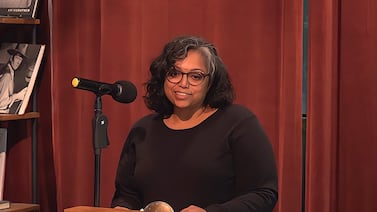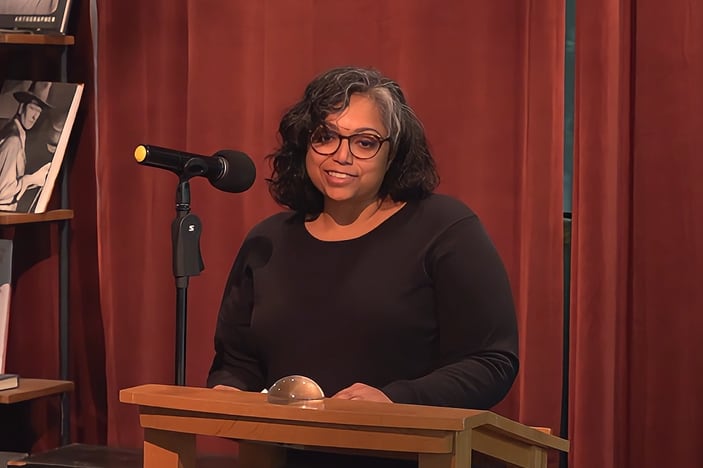
This story was part of Healthbeat’s live storytelling event, “Aha Moments in Public Health,” held Nov. 18 at Powerhouse Arena bookstore in Brooklyn. Watch the full show here. Sign up to receive Healthbeat’s free New York newsletter here.
In the weeks since learning of this opportunity to share stories on community and public health, I discussed with a few close friends how I might attempt to do justice to themes that drive much of how I experience the world. One such friend gently reminded me I had already said most of it to her in our conversations. This is an attempt to share the essence of those exchanges.
The scope of public health can make it seem as though individuals have little effect. Then a moment will remind me what underpins all of it are the individuals themselves – their stories, and everything that led to whatever moment we are in, or decision we are trying to make.
Holding space for genuine connection between those of us working in these spaces and those we serve is essential, because outside these roles, we are all members of a shared idea of community. Through these moments of human connection, people become three-dimensional. Every time we remember and feel this truth, we push back against the false dichotomies of “you versus me” and “us versus them.”
My insights rarely come in a grand way. They present more as blips across time and place. A conversation in New York connects to moments in Michigan, and experiences in India will have a throughline back to another in New York.
One day while volunteering at a food bank in New York City this past summer, I found myself alongside an objectively put together individual. This artist by vocation seemed imbued with confidence and humor. Over hours of shared work and conversation, she revealed her grief over losing a parent when young, her struggles with self-image and eating disorders, and how generational cycles that shaped her family were entangled with larger societal messages about how one’s worth is evaluated. Beneath a surface of style and security was another human being looking for peace while navigating pain and hope.
A few years ago, as part of the team at a no-cost community health clinic in rural Michigan, I was witness week after week to the various needs and truths of those utilizing the clinic’s services. Many patients worked full-time yet could not consistently afford the cost of medications for chronic conditions like diabetes. Chatting with an established patient at the clinic, who never complained if there was a long wait and would stay after his appointment to continue conversing with office staff, I learned over time these moments were one of his main sources of social interaction. Shadowing a bilingual provider and seeing how her ability to communicate fluently, and in a way that developed rapport and trust, revealed additional and relevant layers of a patient’s complex health history, refining their care plan.
When last year I visited relatives in India after years away, I was reminded again of the universality of humans’ desire for self-determination, belonging, safety, and understanding. Sometimes it took different forms within tradition, religion, or social systems, but the essence was the same.
Soon after returning to New York from India, I was part of the care team for an adolescent patient hospitalized for complications related to anorexia. Through many 12-hour shifts together, I came to appreciate her pride in her family’s traditions and spirituality, her desire to honor them while also not being subsumed by them. When her parents came to visit, I witnessed her joy at seeing them, as well as her pain for how their love and despair often echoed the very messages she identified as part of the cycle she was trying to break.
Often, connection seems like a luxury our health care system cannot afford. On the surface, it appears not to fit with health care metrics related to efficiency. But again and again, as a nurse, a volunteer, and a member of this shared community, I have come to see that while science and knowledge give us tools, it is our interconnectedness with other beings that gives us purpose.
One form of that is in the stories we tell, and the space we hold for one another. When we lose sight of this, every protocol, policy, and system we design is similarly limited, as it misses core aspects of what it means to not only exist but have a chance to thrive.
Vidya Thirumoorthi has worked as a nurse in Detroit and, most recently, in New York City at Morgan Stanley Children’s Hospital. She holds degrees in nursing and psychology from the University of Michigan and Wayne State University. Her interests include global health and health equity, with a focus on adolescents and emerging adults.