
Public health, explained: Sign up to receive Healthbeat’s free national newsletter here.
Medicaid is a critical healthcare safety net for millions of pregnant women: More than 40% of U.S. births are paid for by the program. Yet having Medicaid coverage is no guarantee it will be easy to find a doctor or midwife to provide care.
To find one, many women turn to their Medicaid plan’s provider directory. But getting an appointment can require navigating a gauntlet of obstacles: wrong phone numbers, and providers who aren’t actually in the network, providers who no longer practice at listed locations, and practices that aren’t accepting new patients.
Every call takes time when timely prenatal care matters.
As the country grapples with a maternal health crisis, federal investigators warn that problems with Medicaid managed care networks could be making it more difficult for pregnant women to get the care they need.
The issue has been known for more than a decade. Yet a key federal reform intended to expose “ghost providers” in Medicaid networks is still two years away.
Here’s what I found.
The Lead Signal
Medicaid’s maternal care networks may be bigger on paper than in reality.
A recent investigation by the U.S. Department of Health and Human Services Office of Inspector General warned that inaccurate Medicaid provider directories could put pregnant women at risk of delaying or missing important maternal care.
At issue: The provider list errors can make it frustratingly difficult to access care.
The OIG’s investigators examined online directories for a large sampling of OB/GYN physicians and certified nurse-midwives listed as participating in plans from the three largest insurance companies that offer Medicaid managed care plans: Centene, Elevance, and UnitedHealthcare.
These companies’ Medicaid plans covered more than 29 million people in 38 states during 2025, the investigators said.
Yet the OIG’s reviews of provider directories for the companies’ Medicaid managed care plans in Louisiana, Missouri, Nevada, New Jersey, and Washington found significant omissions and errors, including the listing of “ghost providers,” according to the OIG report released this summer.
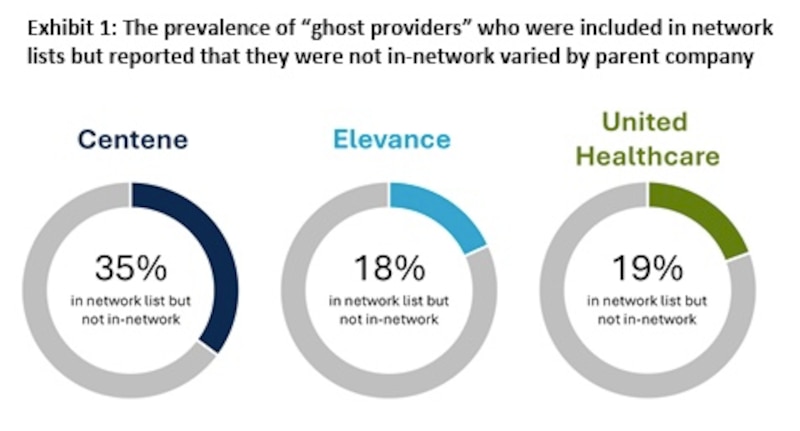
Ghost providers is the term the OIG used to describe maternal care providers who shouldn’t have been listed in the plans’ directories because these providers weren’t participating in the networks that covered patients’ care.
“Some providers reported that they were never in-network with the plan or they practiced in a different State and did not accept out-of-State Medicaid plans,” the report said.
Investigators found that 22% of the maternal care providers Centene’s directories were not actually in-network for the Medicaid managed care plans reviewed. Listing providers who aren’t in-network also can mislead Medicaid enrollees when they are choosing between plans, the report said.
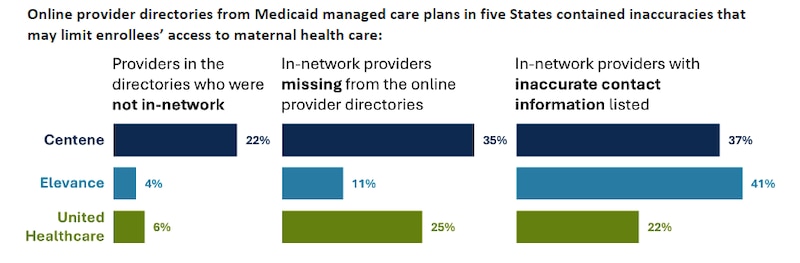
Not only were the lists riddled with providers who weren’t in-network, they failed to include numerous maternal providers who were participating in the companies’ care networks, the investigators found.
And when participating providers were listed, their contact and office location information frequently was inaccurate, making it more difficult to search online for nearby providers.
“Enrollees may delay or forgo care if they experience challenges in finding an in-network provider, which can contribute to worse maternal health outcomes,” the report said.
The problem wasn’t limited to just the directories patients use.
In a companion investigation, the OIG examined the lists that plans operated by Centene, Elevance, and UnitedHealthcare submitted to state Medicaid officials to show their networks had enough providers to meet patients’ needs.
About one-quarter of the listed maternal health providers weren’t in network, despite being represented to the states that they were.
None of the three companies cited in the OIG reports responded to interview and comment requests over several weeks. A spokesperson for Medicaid Health Plans of America, an industry organization whose members include the three companies, referred Healthbeat back to the companies.
Why It Matters
“Imagine sitting on the phone and trying to call to find out if they offer care in between your 15 minutes of time that you have on your lunch break,” said Tina Sherman, national director for maternal health at the advocacy group MomsRising. “It’s almost impossible. Which has been why some families end up entering prenatal care late, which also has ramifications of not getting the full scope of care that they need.”
States pay Medicaid managed care plans a set amount for each person enrolled in their coverage. The companies control costs through a variety of measures, including having a limited group of in-network health care providers who agree to accept the plan’s payment rates.
The plans are supposed to have enough providers to deliver care.
David Machledt, the director of the managed care portfolio at the National Health Law Program, said the OIG reports confirm long-standing concerns about Medicaid networks. He has worked on these issues since 2014 and said he was struck by the size of the provider discrepancies.
“It was actually bigger than what I would have expected,” said Machledt, whose nonprofit organization works to protect the rights of low income and underserved communities.
The Policy Response
Taxpayers pay Medicaid managed care plans hundreds of billions of dollars to provide care, according to the OIG.
For more than a decade, the OIG has called for greater scrutiny and oversight to ensure that Medicaid managed care plans have adequate provider networks. These federal watchdogs have pointed toward “secret shopper” surveys as a powerful oversight tool.
During secret shopper surveys, investigators pose as Medicaid enrollees or a family member and try to schedule appointments. Instead of relying on a plan’s paperwork, the surveys test how easy it is for patients to get care.
In 2024, a Medicaid managed care access rule required states to conduct annual secret shopper surveys to assess compliance with wait times and the accuracy of provider directories. Obstetrics and gynecology is one category of care that must be assessed.
But these assessments won’t start being required nationwide until 2028.
States don’t have to wait.
At least 28 states have used secret shopper surveys in recent years, according to a policy brief published last year.
But not all of them check on maternal care networks.
State Spotlight: Missouri
Missouri’s Medicaid program, MO HealthNet, already uses secret shoppers, but not for OB/GYN care.
The state’s recent secret shopper reports have focused on the accuracy of Medicaid provider directories for primary care providers and psychiatrists.
The state plans to add OB/GYN care to its annual reviews by 2028, said Baylee Watts, a spokesperson for the Missouri Department of Social Services.
Missouri was among the five states in the Health and Human Services OIG probe that found significant inaccuracies in maternal care provider lists.
“MO HealthNet has shared the findings from the HHS OIG reports with Missouri’s contracted managed care organizations,” Watts said by email, adding that maternal health care is a priority and the department provides help to Medicaid participants needing assistance.
A new vendor system for processing provider information should also improve the reliability of directories, Watts said.
What to Watch
Machledt said states have tools to hold managed care plans accountable. The question, is whether they’ll use them.
Every wrong number and unavailable provider shifts the burden of finding care onto patients, Machledt said.
“None of the beneficiaries who are making these phone calls are being paid for the time that they’re investing,” Machledt said. And the bureaucratic hurdles, he said, can lead people to give up on seeking care.
“That can have downstream effects that are really expensive for the system, and more importantly, are consequential to that person’s health.”
Tell us your Medicaid story: Healthbeat wants to hear what’s working and not working with Medicaid. Send your tips to ayoung@healthbeat.org.
Alison Young is Healthbeat’s senior national reporter. Sign up to receive her free national newsletter here. You can reach her at ayoung@healthbeat.org or through the messaging app Signal at alisonyoungreports.48