Public health, explained: Sign up to receive Healthbeat’s free national newsletter here.
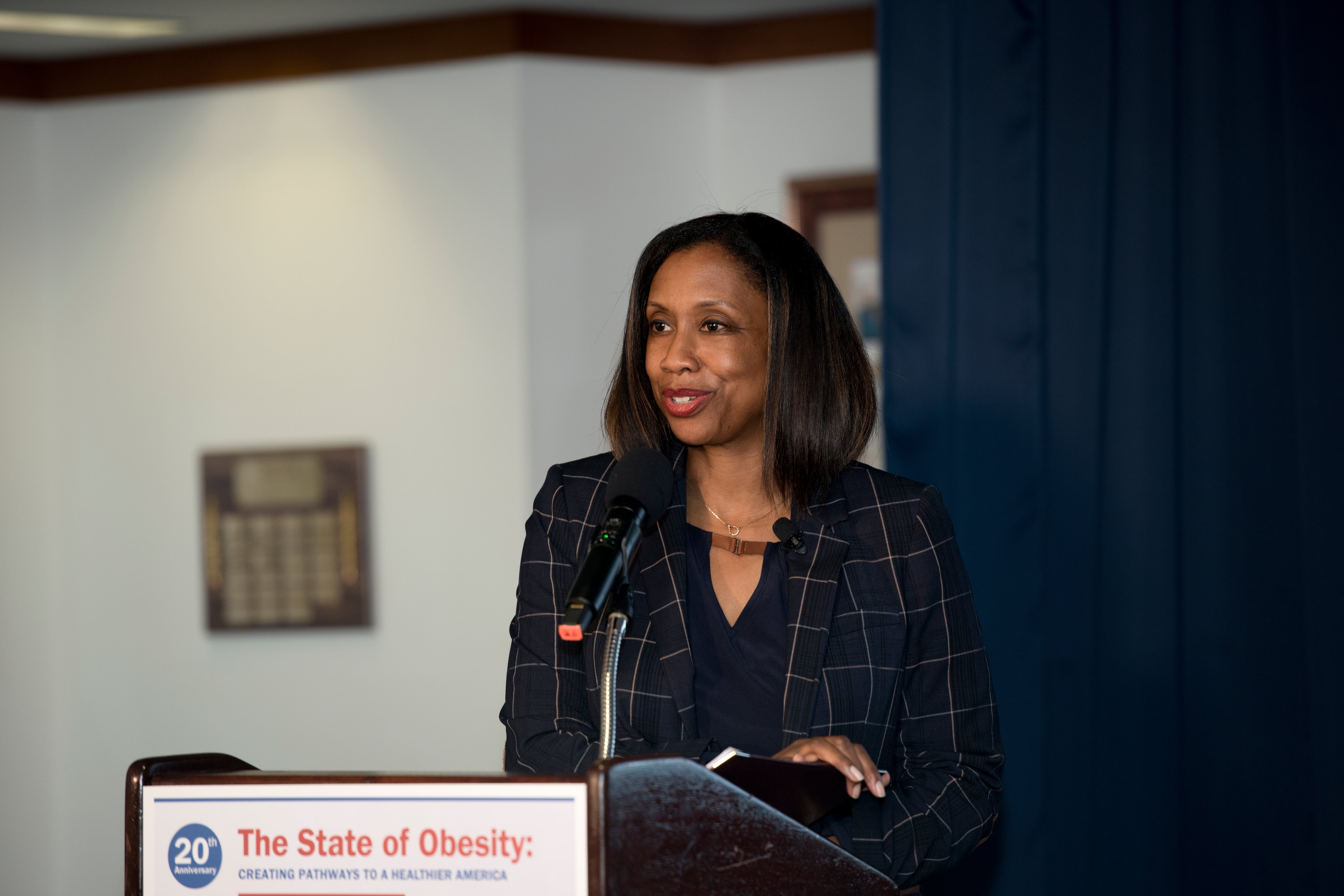
As the child of Haitian immigrants, Dr. J. Nadine Gracia says her professional journey into public health began with her parents’ courage and her own desire to have a career of service.
She initially gravitated toward medicine as a way of caring for others, then served in government, eventually becoming deputy assistant secretary for minority health and director of the Office of Minority Health at the U.S. Department of Health and Human Services during the Obama administration.
Since 2021, Gracia has served as president and CEO of the Trust for America’s Health, a national nonprofit, nonpartisan public health research and policy organization that for 25 years has worked across administrations recommending evidence-based policies to improve public health. She previously served as the organization’s vice president and chief operating officer.
In this 5 From the Field interview, Gracia shares insights on five questions about her work in public health and what she sees as key issues that must be addressed. This interview has been edited for clarity and length.
Federal agencies have been undergoing a lot of changes. What did you learn from your time inside government?
What I saw was really the responsibility and the privilege that we had of being public servants to address the needs of the population.
I had the opportunity to learn from and work with so many career government staff. I just learned so much because of the institutional knowledge, the relationships and partnerships that they brought to the agencies, the subject matter expertise, whether it was scientific expertise or other particular areas of expertise.
What I understood there was the power and importance of partnerships, of engaging with community, of listening to identify priorities, of assuring that if policies did not reach or were not helping to support certain groups and populations, that we needed to be able to address those kinds of structural and systemic barriers to health and well-being, and that government has a key responsibility and lever to be able to create that type of change.
What are the most pressing public health issues that you and the Trust for America’s Health are working on?
Public health is at an inflection point.
How do we continue to protect the public’s health and in that, protect and support the nation’s public health system at all levels? And then on the other side of that: How do we take this moment to reimagine and consider the future of public health?
We know that the public health system wasn’t perfect before. This is an opportunity as well to think about how we strengthen and bolster the public health system. It’s important not only to protecting health. It’s also important for strengthening our economy. It’s important for our national security, and we know that public health has been chronically underfunded.
How do we modernize public health? So many of our systems have been antiquated in terms of data and other areas. It’s also thinking about how we stretch and further enhance partnerships.
So really ensuring that we’re providing Congress, the administration, other federal officials, with the evidence and the information to make informed decisions about funding is critically important.
Where do you see opportunities for partnerships?
Strengthening our partnerships with health care. One would think that these two systems [public health and health care] work seamlessly on a day-to-day basis. But often it’s in times of emergency that we see these systems working more closely together.
We can do even more in non-emergency times to really create this broader health ecosystem.
It’s working, for example, with the business community, because we know that good health is good business. Ensuring that employers understand how to protect the health of their workers.
It’s also looking at the design of communities. It can extend to things like transportation and housing, because we know that our health is influenced more by what happens in the places in which we live, where we grow, where we age, and when we work, than just in the four walls of a doctor’s office or the hospital.
What is something the public doesn’t understand about public health?
One is just an understanding of what public health is and the value of public health.
It often is said that many don’t know what public health is until there is an emergency, until there is an outbreak or a pandemic, until there is some kind of weather-related emergency, like a hurricane or tornado.
Yet public health is working each and every day in every community. It’s making sure that the air that we breathe, the water that we drink, the food that we eat, is safe. It’s ensuring that kids can have a healthy start in life, and mothers are able to thrive through pregnancy and early motherhood.
Public health really needs to be a core part of the infrastructure of every community, that it should have significant investment so that we have a strong system that is able to protect and promote the health of its residents.
What’s at risk – and what is the opportunity – for public health right now?
We risk, for example, the gains that we have made over more than a century in life expectancy. The vast majority of the gains in life expectancy in the country are due to public health interventions.
We are seeing the further rise of rates and chronic disease and other health conditions in terms of rising health care spending. The U.S. spends the most among peer nations in terms of health spending, and yet we have the worst health outcomes across many areas, like infant mortality and maternal mortality, and highest rates of chronic diseases.
When we don’t invest in public health, we have to understand that that’s also not investing in our health security. That is the system that is doing disease detection, that is doing the monitoring for outbreaks and other types of emergencies.
My hope is that the path we chart forward is a path where we understand the value of public health and the return on investment that public health brings to communities and to the nation.
Alison Young is Healthbeat’s senior national reporter. You can reach her at ayoung@healthbeat.org or through the messaging app Signal at alisonyoungreports.48