Public health, explained: Sign up to receive Healthbeat’s free New York City newsletter here.
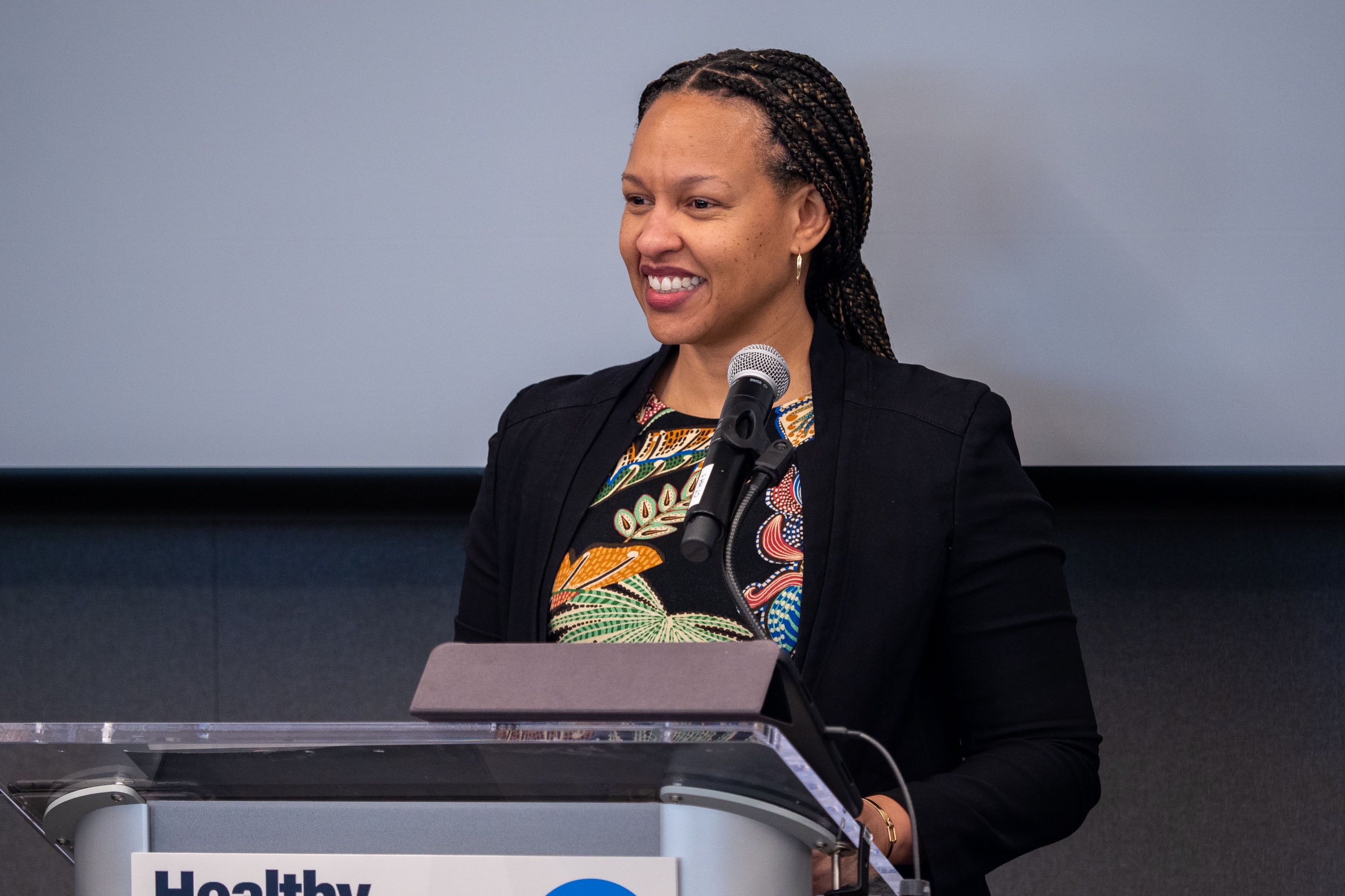
As Dr. Michelle Morse leaves her role as acting commissioner to refocus on her role as chief medical officer at the New York City Department of Health and Mental Hygiene, she plans to stay engaged in her work in health equity and pledges to help the city’s new commissioner navigate the challenges ahead.
In an interview this week after nearly 16 months as acting commissioner, Morse reflected on this moment in public health as Dr. Alister Martin, an emergency room physician in Boston, prepares to take the helm of the department.
“He’s coming in of course at a very, very challenging time,” Morse told Healthbeat in a video interview from her office in Lower Manhattan. “Our whole agency is really committed to making sure that he has what he needs to succeed.”
The new Trump administration has brought upheaval in the federal public health system, which cities and states rely on for funding and support. Looming cuts to Medicaid and food assistance programs are also bringing uncertainty for local officials.
“You just really can’t predict what your era of leadership is going to look like. It is very much shaped by things outside of your control,” she said.
Morse, 44, said she will use her CMO position to develop relationships with her counterparts at the many community health organizations across the city. She also said she plans to return to projects in the works, such as a data-driven tool that compares the number of Medicaid and uninsured patients that a hospital treats to the hospital’s share of beds in the city. And she is eager to support Martin.
The two have had a “few conversations” since Mayor Zohran Mamdani announced Jan. 31 that Martin would run the department, one of the biggest public health agencies in the world with more than 7,000 employees across the five boroughs and an annual budget of $1.6 billion.
Many expected the new mayor to keep Morse in the role; she has been serving as acting commissioner since October 2024. Martin’s resume as a CEO at a health care nonprofit, a Harvard professor, and a White House fellow during the Biden administration shows more experience in health care than in public health. At 37, his leadership experience is limited to small startups.
Morse is a longtime health equity advocate who worked with Boston-based Partners in Health at hospitals in hard-to-reach places like the Haitian countryside. In 2021, she was brought on at the New York City Health Department as its inaugural CMO to bridge the divide between health care and public health.
Dr. Dave Chokshi, a former city health commissioner who recruited Morse as the department’s first-ever CMO, said that “since serving as acting health commissioner, she’s shown really steady leadership for a number of crises that we have faced, including Legionella and a host of other issues. … She has had deep global health experience, even before her tenure in New York City.”
What advice might she have for her new boss?
“That’s the trillion-dollar question,” she said with a smile.
On a more serious note, Morse said she hopes Martin comes to the department with a “learning mindset.” The two will also need to sort out his stimulant beverage of choice, because “it’s a very high-intensity job,” she joked.
Morse said she and Martin can connect on their mutual experiences as Harvard graduate students and later professors at Harvard Medical School and as doctors at Harvard teaching hospitals in Boston: She at Brigham and Women’s Hospital, he at Massachusetts General.
Martin begins his new job on Monday and will report to Deputy Mayor Helen Arteaga Landaverde, who had served as CEO at NYC Health + Hospitals/Elmhurst in Queens and now oversees Health and Human Services for the city.
When Morse looks back on her time as acting commissioner, she points to accomplishments including contributing to a lawsuit filed last year by a coalition of more than 20 attorneys general that sought to block the federal government’s withholding of public health funding of more than $11 billion that had already been allocated for infectious disease prevention. Some $100 million of that in grants had been earmarked for New York City.
“That was at a time when the federal government was really ramping up its attacks against public health,” Morse said. “Those were life-saving funds.”
A federal judge issued a temporary halt on the efforts to block the funding.
Morse cites how the city saw a decline in 2024, for the first time since 2018, in opioid overdose deaths among Black and Latino New Yorkers as another accomplishment, along with “really [doubling] down on using health equity strategies to improve the quality of our work.”
When Morse wore her full-time CMO hat the first time, the New York City Board of Health on Oct. 18, 2021 passed a resolution directing the Health Department to work toward a “racially just recovery” from the pandemic, which had taken a disproportionate toll on communities of color. This, she hopes, will offer guidance for Martin.
“I hope for the future of the agency that we continue to stay true to our deep commitment to health equity,” Morse said. “That is most explicitly and powerfully expressed in that Board of Health resolution declaring racism a public health crisis. That’s on the books forever.”
Trenton Daniel is a reporter covering public health in New York for Healthbeat. Contact Trenton at tdaniel@healthbeat.org or on the messaging app Signal at trentondaniel.88.