This story was originally published by THE CITY. Sign up to get the latest New York City news delivered to you each morning. Public health, explained: Sign up to receive Healthbeat’s free New York City newsletter here.
NewYork-Presbyterian nurses rejected a tentative agreement by an overwhelming margin Wednesday, voting to extend their strike — now 32 days running — against the hospital system.
Their union, the New York State Nurses Association, said the unfair labor practice strike and bargaining will continue. Out of about 4,200 NewYork-Presbyterian nurses who were eligible to cast ballots, 3,099 voted to reject the deal, and 867 voted to approve it.
At Mount Sinai, Mount Sinai Morningside and West, and Montefiore, nurses voted to approve their contracts Wednesday evening by margin of 87%, 96%, and 85% respectively and will return to work this weekend.
A NewYork-Presbyterian spokesperson said the hospital was “disappointed that our nurses did not ratify the mediator’s proposal, which we accepted on Feb. 8 and NYSNA leadership endorsed.” The spokesperson, Angela Karafazli, said the hospital is willing to honor the rejected proposal for reconsideration.
Nancy Hagans, the president of NYSNA, called on the hospital to “agree to a fair contract and bring all of our nurses back to work.”
Nurses at the three hospital systems have been on strike since Jan. 12 trying to secure stronger nurse-to-patient ratios, claiming that staffing shortages put their and their patients’ well-being at risk.
Nurses demand investigation
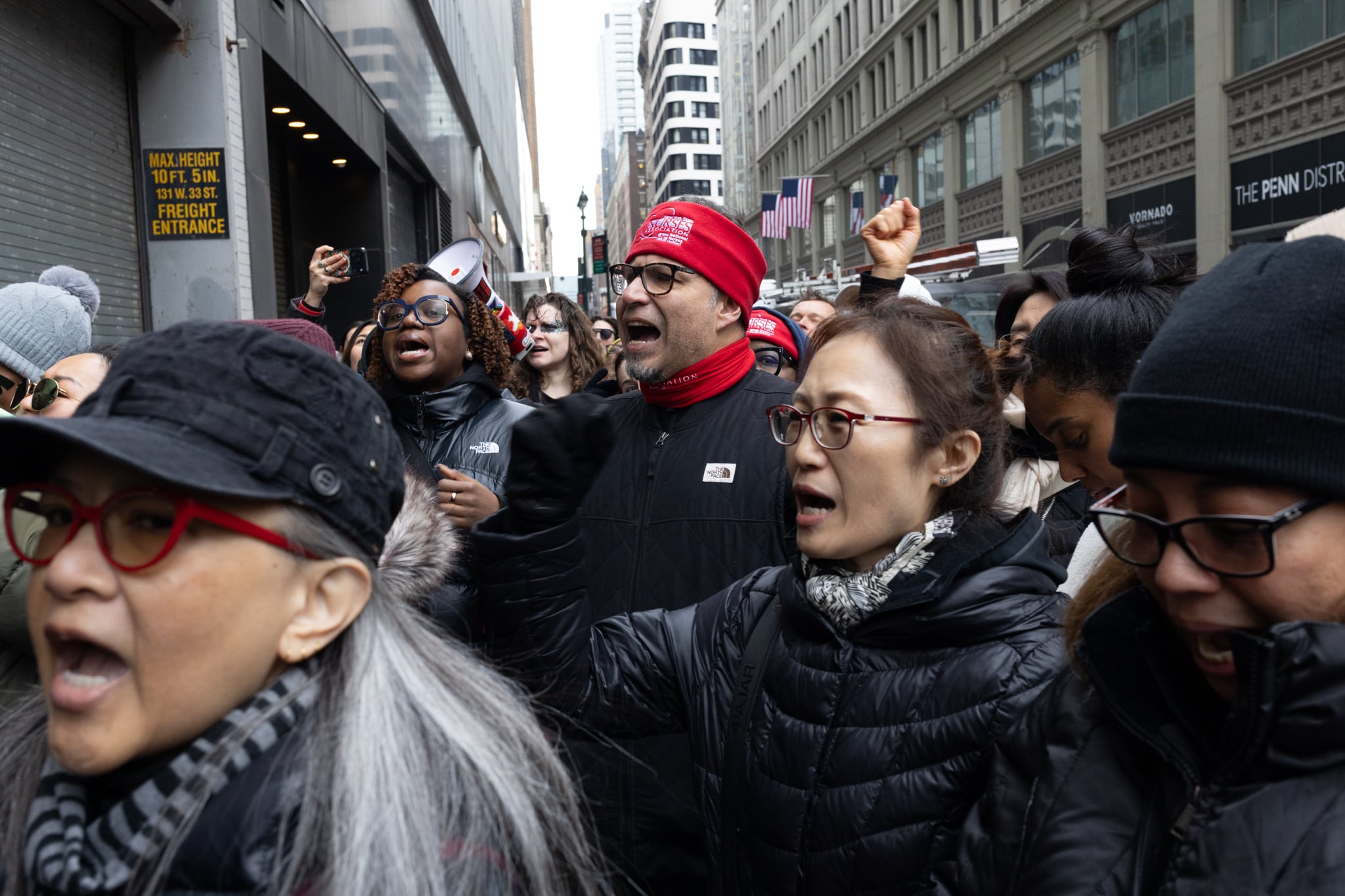
The dramatic development unfolded hours after more than 50 nurses delivered a petition to the NYSNA headquarters demanding a formal disciplinary investigation into top union leadership over members’ claims that leaders are forcing a vote on a tentative agreement with NewYork-Presbyterian that rank-and-file representatives rejected at the bargaining table.
It was not immediately clear what mechanism the union has to investigate the actions of its two top executives, said Hagans and Pat Kane, NYSNA executive director. Nurses also demanded that the findings of the probe be subject to a full hearing open to all of its members.
More than 1,500 nurses signed the petition in the hours after NYSNA and NewYork-Presbyterian announced the agreement that nurses ultimately voted to reject on Wednesday.
NYSNA’s decision to forge ahead with a vote at NewYork-Presbyterian had infuriated members who said they stood by their executive committee’s assertion that the deal did not meet their needs. NYSNA has executive committees at each of its hospitals; those committees are made up of union members who participate in contract negotiations.
Beth Loudin, a neonatal nurse and member of the executive committee at NewYork-Presbyterian, said top union leadership informed her it was moving ahead with a vote Tuesday afternoon — days after she and the committee originally rejected it.
“I can’t even call it a memorandum of agreement, because there’s no signature on it,” Loudin said. “This is a rush job to get a vote out, because it’s in alignment with the other hospitals. It was very jarring.”
The three-year agreement was pending ratification by the union’s rank-and-file members, who had until 5 p.m. Wednesday to approve or reject the deal. The tentative agreement included the same 12% salary increases that the union secured in earlier deals with Mount Sinai and Montefiore, but it did not guarantee nurse-to-patient ratio enforcement language available to nurses at those hospitals.
On Tuesday, Kane, the union’s executive director, addressed the controversy at NewYork-Presbyterian in a video to members that was included in an email with the ballot, first obtained by Gothamist: “The simple fact is that we’ve reached the end of negotiations.”
“They are overriding our voices,” said NewYork-Presbyterian nurse educator Cagatay Chelik.
Nurses marched from Macy’s on 34th Street to the union’s headquarters a block south on West 33rd to deliver the petition on Wednesday, chanting, “We are your nurses! Listen to your nurses!”
Asked for comment on the union members’ petition and protest, a NYSNA spokesperson referred THE CITY to an earlier statement by Hagans, the union’s president, where she urged her members not to rush to judgment.
“We believe all striking nurses deserve to see the details of their tentative agreements and get the opportunity to vote on whether to ratify a new contract,” Hagans said. “As a democratic, member-led union that responds to its members, we are moving forward with a vote on tentative contracts at all four hospitals with the goal of returning all nurses to work as soon as possible.”
Loudin and about a half-dozen other union colleagues became visibly emotional as they delivered the signed petition to NYSNA’s general counsel and contract specialists who were summoned to the lobby to meet with the protesting nurses. Hagans and Kane did not meet with the nurses.
“It’s been truly painful personally that my union decided to go against my leadership and my nurses,” Loudin told the union’s contract specialists. “We’ve been fighting for this for six months.”
‘Sold us out to management’
The strike is the longest and its kind in New York City history; at its peak, with 15,000 members across all four hospital systems on the picket line, it was also the largest. Nurses struggled to make ends meet over many weeks on the picket line without health care or their paychecks. The hospitals cancelled elective procedures, rerouted patients to hospitals unaffected by the work stoppage, and collectively paid about $100 million for travel nurses to staff their facilities during the strike.
Mount Sinai CEO Dr. Brendan Carr on Wednesday cheered the nurses’ return to work, and acknowledged the rancor of the past month in a statement to staff.
“The past several weeks have been challenging, emotional, frustrating, and exhausting in different ways for all of us,” Carr wrote. “As I have said many times over the past several weeks, thank you again to everyone who played a role either big or small to help us navigate these challenges. We never lost sight of the fact that our patients always come first.”
NewYork-Presbyterian nurses who spoke with THE CITY earlier on Wednesday said they felt betrayed by their top leaders.
“Unfortunately now we’re at a point in which our union’s senior leadership, specifically our executive director and the president, have sold us out to management,” said Esteban Barrena, a nurse at NYP-Morgan Stanley Children’s Hospital.
The union had touted the tentative agreement at NewYork-Presbyterian as a victory for nurses, securing commitments to preserve the union’s health care and benefits and to hire more staff in order to improve nurse-to-patient ratios.
The union’s executive committee had rejected the deal because the staffing proposals that the mediator had recommended would not guarantee job security for existing nurses, Loudin said. It also does not include the same staffing ratio enforcement language that nurses at Mount Sinai and Montefiore have had in their contracts since 2023, which the union has touted as some of the most secure in the country.
“This is the reason we’ve been fighting for all of this,” Barrena added. “Why would union leadership compromise on that?”
Claudia Irizarry Aponte is a senior reporter covering labor and work for THE CITY.