This story was originally published by THE CITY. Sign up to get the latest New York City news delivered to you each morning. Public health, explained: Sign up to receive Healthbeat’s free New York City newsletter here.
Negotiations between the New York State Nurses Association and three hospital systems broke down again over the weekend, dashing the hopes of a potential resolution to a strike involving 15,000 nurses now in its second week.
NYSNA, the nurses’ union, said it had submitted a revised set of proposals heading into weekend bargaining with Mount Sinai, Montefiore and NewYork-Presbyterian, but talks went nowhere. The union is demanding better staffing, improved on-the-job safety, and maintaining health benefits. But the hospitals are dug in on rejecting those demands as unreasonable. The hospitals have reportedly spent $100 million on temporary nurses, according to a leading trade group.
Only Montefiore submitted counterproposals addressing workplace violence during a marathon bargaining session Sunday evening, though no meaningful progress was made, according to union sources. Mount Sinai and NewYork-Presbyterian rejected the nurses’ revised proposals without countering, and no additional bargaining sessions had been scheduled as of Tuesday afternoon.
The breakdown was the latest development in a strike more bitter than any in recent memory. The nurses’ union has lodged more than a dozen complaints against the three hospital systems accusing them of violating U.S. labor law, including by retaliating against nurses for organizing.
At Mount Sinai, the union accused administrators of unlawfully disciplining — and in some cases firing — pro-union nurses. Mount Sinai, in turn, has accused striking nurses of “bullying” travel nurses, a charge the union denies.
Michelle Gonzalez, an oncology nurse who sits on the Montefiore bargaining committee, said that safety is the union’s top priority, and she described how the loss of beds has led to overworked nurses tending to patients in hallways.
“There’s a certain amount of moral duress that comes from dealing with these conditions for both the patient and for the provider,” said Gonzalez. “And that’s why we cannot accept from them this idea that there’s nothing that [the hospital] can do.”
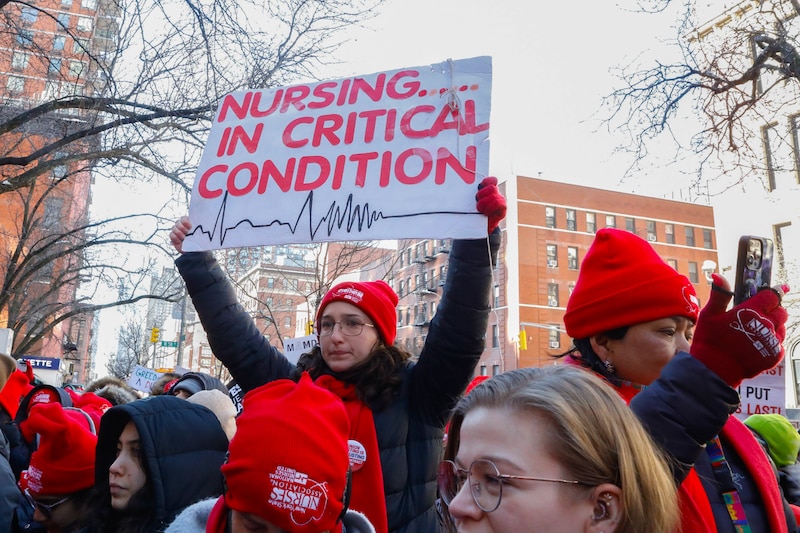
The strike, which the union claims is the largest of its kind in New York City history, has already eclipsed the duration of a smaller strike in 2023 that resulted in improved nurse-to-patient staffing enforcement mechanisms the hospitals are now attempting to roll back.
Pickets continued at nine hospital facilities through the long weekend as real-feel temperatures plunged to the single digits. On Tuesday morning, nurses at Mount Sinai West were joined by Mayor Zohran Mamdani, in his second visit to the NYSNA picket line, and U.S. Sen. Bernie Sanders, I-Vt., both of whom urged hospital representatives to come back to the bargaining table.
“The people of New York City, the people of Vermont, the people of America, love and appreciate our nurses. And today we say to those hospitals: Sit down and negotiate a decent contract,” Sanders said, prompting chants of “Bernie! Bernie! Bernie!” from the scores of nurses and supporters in attendance.
Earlier Tuesday morning, NewYork-Presbyterian spokesperson Angela Karafazli said the hospital was “working through the mediator” to schedule the next bargaining session. Mount Sinai CEO Brendan Carr said in a notice to staff on Monday that the hospital “extended our plans to run the Health System without the support of the nurses NYSNA leadership has convinced to strike.”
Montefiore strategic communications executive Joe Solmonese said the union’s demands were “reckless and dangerous.”
“Until they can back away from their reckless and dangerous $3.6 billion demands, progress overall will not be possible,” he said. “In the meantime, we continue to provide the world-class care our communities deserve.”
Nurses who spoke with THE CITY said that hospital management has been emboldened by what they described as the Trump administration’s anti-worker agenda to reverse the union’s previous victories. The union, the nurses said, was more determined than ever to hold the line.
“It’s not just about nurses: This is to try and teach the working class that we are not in power, that who has power is the 1% — the CEOs and the rich,” Gonzalez, the Montefiore nurse, said. “We’ve had this erosion of our contract that they’re trying to do right now because they feel empowered and emboldened, in my opinion, by the Trump administration.”
“If they succeed in breaking our power and what we’re fighting for here in New York, taking away health care for nurses, they’re going to do this in every other unit, and in every other state,” said an OB-GYN nurse at Mount Sinai Hospital who declined to give her name. “So this fight is about more than just us.”
Claudia Irizarry Aponte is a senior reporter covering labor and work for THE CITY.