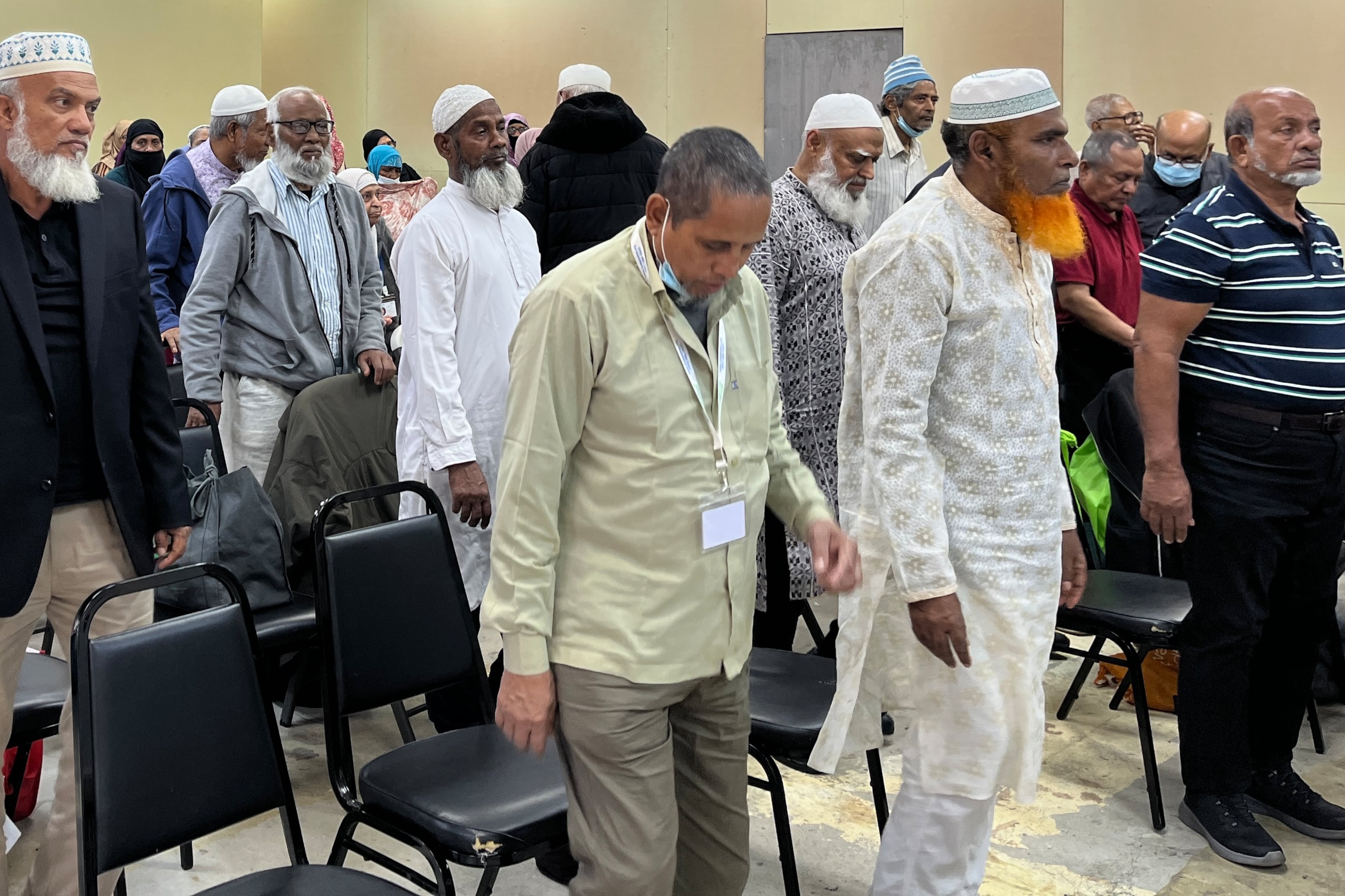
This story was part of Healthbeat’s live storytelling event, “Aha Moments in Public Health,” held Nov. 18 at Powerhouse Arena bookstore in Brooklyn. Watch the full show here. Sign up to receive Healthbeat’s free New York newsletter here.
My story begins far from Queens, in a small, quiet village in Andhra Pradesh, India, called Bangaramma Peta.
In that village lived a gentle, scholarly man named Vangapadu Lakshmi Naidu — my father.
A man who spent his days surrounded by books, ideas, and the calm joy of thinking deeply.
But one day, age brought a silent thief: vascular dementia. Slowly, the words he loved so dearly began slipping away … until even the names of the people he loved were out of reach.
At the time, I was a young psychiatrist in New York.
I understood dementia in theory. But when it hit home — my home — none of the textbooks could prepare me for that pain.
And what hurt most was this: There was nowhere for him to go. No community center in his village. No space to meet people his age, talk, laugh, belong.
He was isolated. And that loneliness broke him, long before the disease did.
I wanted to bring him to New York, but when I looked for culturally appropriate senior care, I kept hearing things like: “We don’t have any curry-serving facilities.”
If doctors can’t figure it out, what about elders who don’t speak English so well, whose routines were built over decades half a world away?
In my circles, I met families like Dr. Kiran Dave, whose late mother, Swarupa Kumari, faced Alzheimer’s disease with few culturally appropriate programs.
And Dr. Deepika Sood, whose father, Dr. Nagarajan, spent his final years yearning for conversation, community … connection.
Different families. Same pain.
My father made me a doctor at a time when girls were not always encouraged to study — especially in a village like ours.
And yet … when he needed care the most, I couldn’t give him what he truly needed — a space to belong, to be understood, to feel at home. That is the ache that never leaves.
But it is also the fire that built India Home.
Because while I couldn’t change his ending, I can change the story for someone else’s father, someone else’s mother.
And in doing so, I honor him every single day.
In 2007, I and my friends founded India Home, a nonprofit organization.
My goal? To build a space where our elders could age with dignity, connection, and cultural pride.
It started small. In 2008, India Home established the first senior center catering to South Asian values and culture at the Services Now for Adult Persons of Eastern Queens.
A few aunties. A few uncles. Some chai. Some samosas
And today?
Let me share what that India Home care looks like — not just in feeling, but in real numbers:
Reach:
- Operates five senior centers in Queens.
- Has served 5,000+ South Asian and Indo-Caribbean seniors since inception.
Nutrition:
- Provided 60,000 congregate meals and 5,200 home-delivered meals last year.
- Hosted 70 food pantries.
- Provided 4,600 nutrition education units.
Health and wellness:
- Provided 49,000 physical exercise sessions, plus yoga, meditation, and health education.
- Hosted 20 mental health group sessions.
Creative aging:
- Provided 4,400 arts and culture activities (painting, crafts, karaoke, jewelry making).
- Provided 1,300+ technology sessions for digital literacy. (Yes, we teach WhatsApp. Because nothing says connection like 73 unread messages from your cousin in Delhi.)
Dementia care:
- Offers “Desi Dementia Daycare” (3D Care) for mild to moderate dementia, with cognitive and physical activities and provide caregiver support.
Housing:
- Operates innovative co-living homes in Queens for vulnerable seniors, providing shared living and case management.
Case management:
- Assistance with SNAP, SSI, Section 8 housing vouchers, Access-A-Ride, and rental aid.
- 90% success rate in benefits applications.
Community education:
- Provided 21,000 education units in English as a second language, citizenship coaching, elder abuse prevention, know your rights informational sessions, Arabic classes, and health workshops.
Special initiatives:
- SACCHI Project: South Asian Colon Cancer Health Initiative reached 40,000+ people with culturally adapted education.
Future plans:
- Renovating main center into South Asian Community Home with library, arts and crafts corner, and technology lab.
- Providing 100% low-income affordable housing units to seniors.
At India Home, our elders don’t just receive care. They rediscover community.
And the best part? You walk in, and you feel it.
You hear Hindi, Gujarati, Bengali, Urdu, Punjabi, English, Telugu, Tamil, Malayalam, Kannada, Sinhala, Creole … You smell spices – cumin, cardamom, and tea.
You hear laughter — not from staff, but from elders rediscovering joy.
One aunty told us, “I don’t wait for weekends anymore. I wait for Mondays, so I can come back to India Home.”
When Mondays become popular, you know you’re doing something right.
And this — this space — it’s not just for our parents. It’s for us.
Because one day, we’ll be those elders. Hopefully doing yoga. Probably gossiping after it.
And when that day comes, we’ll want a space that gets us.
India Home is now a national model for culturally competent elder care. But to me, it’s something more personal.
Every smile I see there carries a piece of my father’s legacy. He taught me that words can heal.
India Home is my way of giving that healing back. One elder. One story. One day at a time.
What happens when compassion meets culture? You get India Home. A place where aging is not endured … but celebrated.
Dr. Vasundhara Kalasapudi, known as Dr. K., is a psychiatrist specializing in geriatrics. She is founder and executive director of India Home. Her story was read at Healthbeat’s event by India Home treasurer Neetu Jain.
India Home was a sponsor of the event.