This story was part of Healthbeat’s live storytelling event, “Aha Moments in Public Health,” held Nov. 3 at Manuel’s Tavern in Atlanta. Watch the full show here. Sign up to receive Healthbeat’s free Atlanta newsletter here.
I was a career scientist at the Centers for Disease Control and Prevention for nine years, and a public health professional for over 20 years. I’ve had many “aha” moments over the years.
My first “aha” moment was when I was 10 years old. I was sitting on the couch with my grandmother watching a movie, as we did every time I visited. I saw helicopters, people in uniform, and lots of action. The thing that stood out for me was being curious about what a “BSL” was. I saw BSL 1, BSL 2, BSL 3, and so on. This was the opening of the movie “Outbreak.”
If you don’t know, BSL stands for Biosafety Level, with 1 being the lowest.
I was a curious kid, always questioning things and discovering answers to the world. You can imagine how much my parents loved hearing from me constantly!
Some may have watched that movie and thought they wanted to be Dustin Hoffman, the virologist investigating the outbreak. I always wanted to be Rene Russo. Why? Because she was the one who practiced public health and science in the movie the most.
My “aha” was learning that I didn’t want to be the person who knew how government or knowledge was controlled and dispensed, but rather the person who was on the ground with the people it affected. Rene Russo embodied the sacrifices and the leadership that changed the entire outcome of the film. At 10 years old, I wrote an “essay” … if you can even call it that … about how I wanted to be a scientist, and it propelled me on a linear track to achieving that goal.
My second “aha” was becoming a scientist. I realized I didn’t really know much about how to do this job. I was thankful for career scientists and mentors who guided me through the process. If you would have told me it would take a decade to understand the science, and then another decade to understand how I fit into the science, I don’t know if I would have continued on my path. So I had another “aha”: that we don’t have to know it all. Part of public health is constantly learning, and I appreciated that so much when that came to be for me.
My third “aha” was learning that as a civil servant, and one who dedicated their life to saving others, that I would never give up or halt in my efforts. The job is neverending. And so to relate back to my favorite movie “Outbreak,” my second was “The NeverEnding Story.”
Many of us can likely relate to this … who didn’t want a Falcor in their life? But the impact of that movie in the scene with the horse, Artax, is in the Swamp of Sadness. We remember that scene because it was the sensation of leaving your most beloved thing behind. That, in many ways, is what it feels like to be dismissed from duty at the CDC in public health professions.
With all that said, I continue to question, to be curious, to investigate, analyze, and report on my life, assisting others who need information, and to support the wider communities who rely on our strongest efforts. Because who am I without everyone else, and with the sadness of our professions being attacked … we persevere.
Thank you, and with solidarity,
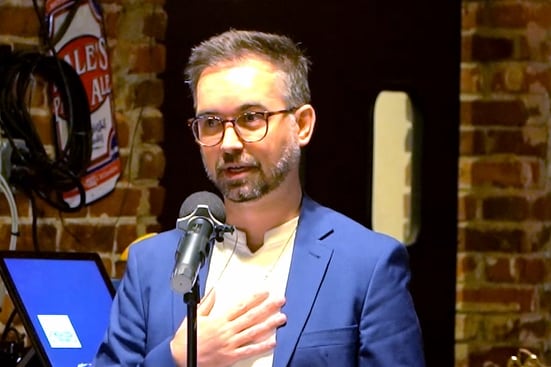
I’m Brandon Kenemer.
Brandon Kenemer is an associate director for informatics focused on data science, surveillance, communications, and bioinformatics at the Centers for Disease Control and Prevention. Previously, he worked in psychology, behavioral health, and nursing care.