Public health, explained: Sign up to receive Healthbeat’s free national newsletter here.
Public health is inherently political because it often involves policy decisions, but it shouldn’t be partisan.
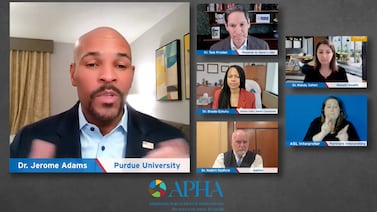
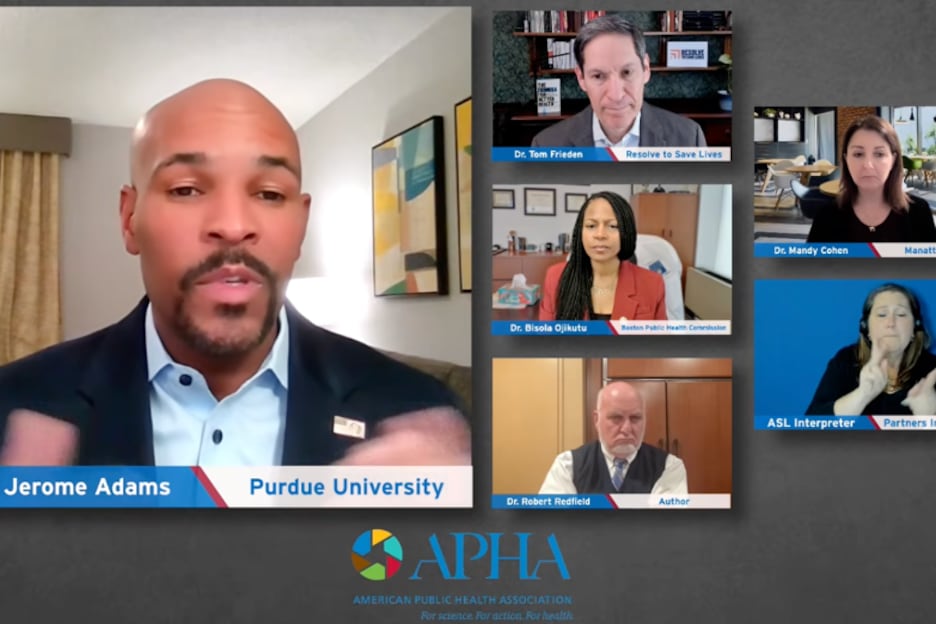
That was among the key messages during the 2026 State of the Public Health Union webinar Thursday with three former directors of the Centers for Disease Control and Prevention and a former U.S. surgeon general who served under Republican and Democratic administrations. The 90-minute event, which can be watched on YouTube, is organized annually by the American Journal of Public Health.
Here is one takeaway from each of the four speakers.
Dr. Tom Frieden, former CDC director (2009-17)
Frieden served as CDC director under President Barack Obama. He is now president and CEO of Resolve to Save Lives, a global health organization.
“I don’t agree with the statement that we have to get the politics out of public health. I think we need to get the partisanship out of public health. There are decisions about public health that communities should make. At what [blood alcohol] level should we tell people that they shouldn’t drive? … Should we take over land to make safe water for our community? Does a community decide to be smoke-free in their restaurants or bars or parks? These are community decisions. They’re policy decisions. What has infected public health over the past few years is a partisanship. I think this is something that all of us – right, left, Democratic, Republican, progressive, conservative – should try to address. Sen. [Daniel Patrick] Moynihan used to say that you’re entitled to your own opinion, but not to your own facts. And unfortunately, today, it seems like people feel they’re entitled to their own facts.”
Dr. Jerome Adams, former U.S. surgeon general (2017-21)
Adams served as surgeon general during President Donald Trump’s first term. He is now executive director of the Center for Community Health Enhancement and Learning at Purdue University.
“We’ve got to reclaim public health as consistent with conservative principles, not against conservative principles. It’s about personal responsibility, strong families, a ready workforce, military preparedness, and reducing wasteful downstream spending. Those are all conservative principles. Prevention aligns with fiscal responsibility. Clear, accurate information aligns with individual liberty, because you can’t make an informed choice without trustworthy facts. Second, we need trusted messengers. And in many conservative communities, people are going to be far more likely to trust their pastor, their local physician or pharmacist or nurse practitioner, their sheriff, or their governor than they are any federal agency. So that means empowering state and local leaders and respected voices within conservative circles to speak clearly and consistently about evidence-based health information. And then third, we’ve got to be willing to call out misinformation even when it’s politically inconvenient to the point I raised earlier. If we stay silent, when bad information spreads because it benefits our side, we lose credibility.”
Dr. Robert Redfield, former CDC director (2018-21)
Redfield served as CDC director during Trump’s first term. He is now a senior visiting fellow for biosecurity and public health policy at the Heritage Foundation, a conservative think tank.
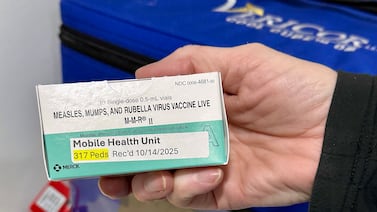
“We need to learn how to share our differences of opinion on public health issues, but to do it respectfully ... I’ve said many times that vaccination, I think it’s one of the most important gifts of science to modern medicine. And it’s very disconcerting to see people being encouraged to leave it on the shelf rather than to embrace it. But I think if we could just have a little more honest debate among ourselves about different opinions on what policy directions we think we should go, but to do it in a respectful way, knowing that, you know, each of us really cares deeply about the public health of our nation, and we may see things slightly differently … When we see things that are obviously true, we need to speak out and clearly say that they’re true. For example, we’re dealing as you know now with measles in South Carolina, in Florida, in Texas, in Arizona. And we all know that the best way to stop the measles pandemic is to get the American public vaccinated against measles. Period. There doesn’t need to be any qualifiers around that.”
Dr. Mandy Cohen, former CDC director (2023-25)
Cohen served as CDC director under President Joe Biden. She is now a national adviser at Manatt Health, a health care consultancy.
“In order for us to fulfill our mission of protecting health and improving lives, we need the federal government – and state and local governments – all working well and working together. But there are things that you do not want to create, state by state by state. Some of that is certainly a data architecture, right? … [Public health cannot do its job] if you don’t have that visibility of what’s going on, both around you and, frankly, internationally as well. So CDC certainly has to maintain those connectivities and the data systems. But then it’s also expertise. We have wonderful experts at the state level, but they can’t be an expert in every rare pathogen. And so having both the laboratory expertise, the pathogen-specific expertise at the federal level is really important … I am very concerned about us pulling back in our global footprint. And that is something that needs to be done in a coordinated way at the country level, at a federal level, so that we are making sure to protect us here at home. So those are the things the feds need to do.”
Alison Young is Healthbeat’s senior national reporter. You can reach her at ayoung@healthbeat.org or through the messaging app Signal at alisonyoungreports.48