Public health, explained: Sign up to receive Healthbeat’s Global Checkup in your inbox a day early.
Hello from Nairobi.
This week’s edition has an unexpected through-line. Several stories reveal how the global health system is preparing for a long season of austerity: from staff cuts at the World Health Organization, to a disappointing funding cycle for AIDS, tuberculosis and malaria control, to functioning drugs being abandoned over limited profit prospects. I’m trying to follow where bold pivots are being made, or where tough decisions are just being avoided.
My name is William Herkewitz, and I’m a journalist based in Nairobi, Kenya. This is the Global Health Checkup, where I highlight five of the week’s most important stories on outbreaks, medicine, science, and survival from around the world.
With that, as we say in Swahili: karibu katika habari — welcome to the news.
The big fundraiser with small donor energy
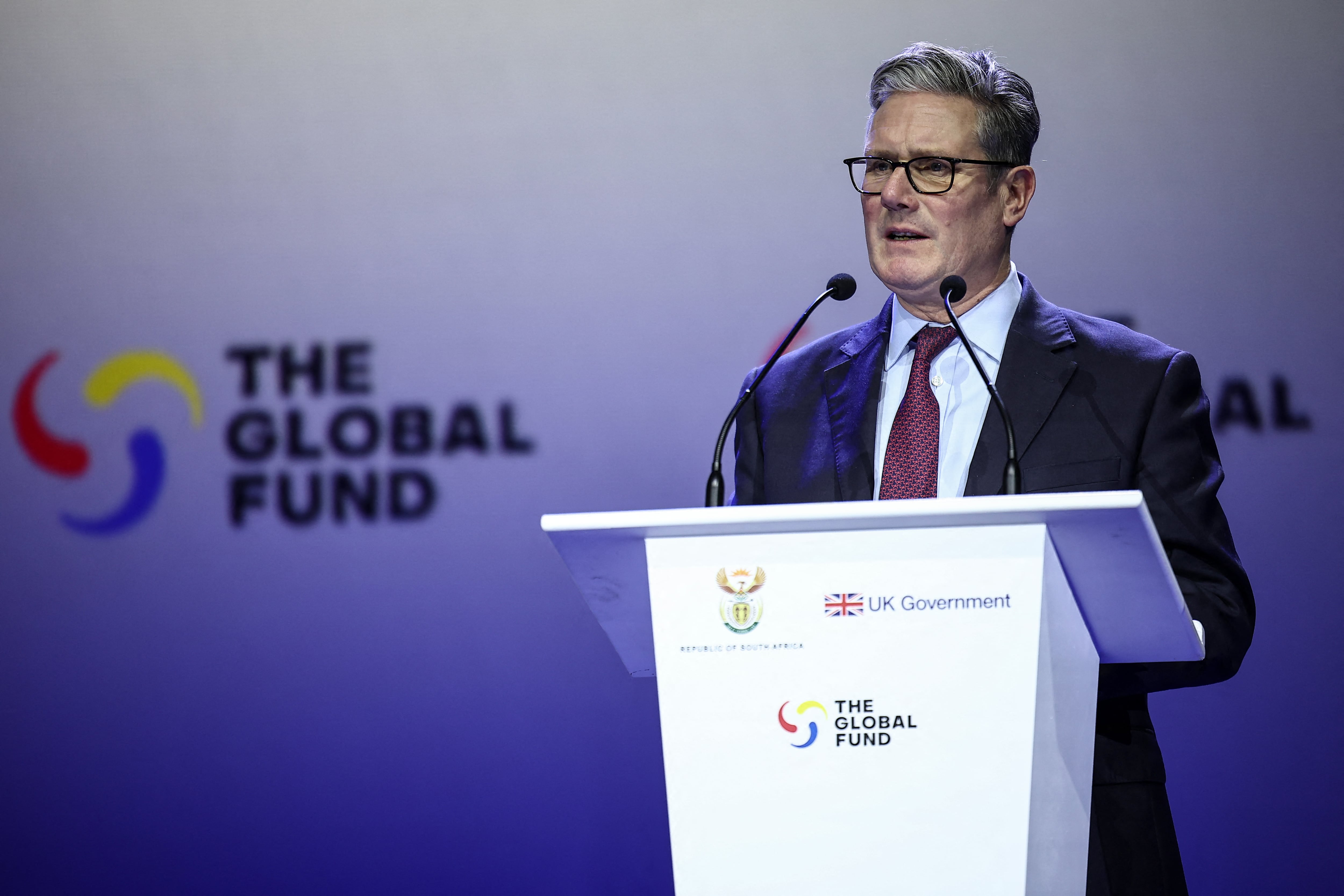
Since we’ve last checked in, the Global Fund wrapped up its odd, tri-yearly fundraising conference. (I’ve previously described it as “the part telethon, part diplomatic speed-date,” which decides how much money the fund will actually have to work with.)
So how did it go?
Not great. Health Policy Watch reports that the conference ended with $11.3 billion, a full third short of its $18 billion goal. That’s also more than a quarter less money than the fund received in the previous cycle. While not exactly a worst-case scenario, the shortfall is a shocking drop for one of the central institutions in global health.
- A bit of context: The Global Fund is a massive, 23-year-old organization that collects donations from wealthy governments and funnels them into programs that fight AIDS, tuberculosis, and malaria in more than 100 countries. It sits at the center of the global push against all three diseases. For example, about 60% of all international financing for malaria control still moves through this one institution.
There’s plenty of blame to spread around, but the drop is largely a reflection of a pullback from the fund’s largest historical donors. The UK cut its contribution by 15%, Germany by 23%, Canada by 16%, and Japan by more than half. But by far the largest hit comes from the United States, which went from $6 billion last cycle to $4.6 billion this time, a 23% drop. (France and the European Union are TBD; they didn’t pledge in the conference.)
There’s a lot to be said about the impact this shortfall will have on real lives and real illnesses, which we’ve covered before. But for now I’m left wondering: Is there any path forward that isn’t just … doing less with less money?
I reached out to Janeen Madan Keller, the global health policy deputy director at the Center for Global Development (which is a leading global development think tank) about this shortfall and what the fund should do now.
Keller and her colleagues have written a policy paper about just this, where they “propose a new funding model that protects grants for the poorest countries and provides loans to wealthier countries,” she says.
One advantage of their proposal is that it “helps shield the poorest countries from funding cuts, and the reflows from these loans provide a financial cushion for the Global Fund, making it less reliant on donors as the sole source of funding,” Keller says. It’s a bold path forward that could help the Global Fund survive a long winter of donor austerity.
In a blog accompanying the paper, Keller and her colleagues note that “a combined grant and loan model at the Global Fund could generate up to $1 billion each year in new financing by 2033 without reducing grants to the poorest countries.” That would be roughly enough to reset the organization’s finances back to its last funding cycle.
Still, the approach would leave some tough questions to be answered. “Would middle-income countries … borrow for health?” Keller and her colleagues ask.
Rising toll in Ethiopia’s first Marburg virus outbreak
Since we last checked, the death toll from the Marburg outbreak in southern Ethiopia has climbed to eight confirmed fatalities, with a total of 12 lab-confirmed infections (including the dead), the African Press Agency reports. Ethiopian authorities say that while only four patients remain under treatment, almost 400 contacts have been traced and monitored.
It is a grim but unsurprising escalation for the Ebola-like virus, which has no vaccine and kills over 90% of untreated patients. What’s the takeaway?
Honestly, it’s not really possible to distill from these numbers whether we are seeing an unrivaled success, a fumbling failure, or something in between. Even a sharp dip in reported cases in coming weeks might signal control … or just a widening blind spot. Still, officials insist field teams are moving quickly. But it’s just too early to assess how well the contact tracing and containment efforts are working.
Hope lies in the fact that Monday marked the official end of the Ebola outbreak (!) in the Democratic Republic of the Congo, a victory I’m choosing to read as evidence that the international community can muster the resources and urgency needed to respond effectively in Ethiopia.
Bird flu’s pandemic potential
The medical director of one of Europe’s top labs for studying flu and other airborne viruses — France’s Institut Pasteur respiratory infections center — has just raised a public warning about bird flu, Reuters reports.
Marie-Anne Rameix-Welti says the ongoing bird flu epidemic, which is tearing through bird populations globally, carries the very real risk of evolving human-to-human transmission. That shift could spark a global outbreak “potentially even more severe than the [Covid-19] pandemic we experienced,” she warns.
Right now, the virus remains largely confined to birds with only rare spillovers into humans. For example, while Washington state reported a case last month, it was the first in the United States since February.
The danger in bird flu lies in the fact that humans have no immunity to either of the major strains, which are H5N1 and H5N5. (The H and N numbers refer to the shape of two important proteins on the outside of the virus.) “People have antibodies against common H1 and H3 seasonal flu, but none against the H5 bird flu affecting birds and mammals, like they had none against Covid-19,” Rameix-Welti says.
The good news? Researchers say the odds of that evolutionary leap, as best we can estimate, are small. And the last pandemic dramatically improved our preparedness. Compared to Covid-19, “we have specific preventative measures in place. We have vaccine candidates ready and know how to manufacture them quickly ... we also have stocks of targeted antivirals that, in principle, would be effective against this avian influenza virus,” she says.
WHO to cut a quarter of its workforce
I’ve worked in international development long enough to hear plenty of moaning about the slow, recursive bureaucracies of the United Nations and the WHO (and yes, about the U.S. Agency for International Development, as well). And after a decade inside a government machine, my inner libertarian has learned to trust most complaints about inefficient or downright dysfunctional systems.
That said, I have to offer a small mea culpa.
Since starting the Global Health Checkup, I’ve gained a profound appreciation for just how much the WHO quietly holds together. From the big stuff, like detecting and containing disease outbreaks or moving supplies for global health crises, all the way down to the quotidian work of publishing the data and guidelines everyone else relies on.
But that brings us to The Guardian’s reporting that the WHO is preparing to cut roughly a quarter of its global workforce.
Is there any silver lining here? In theory, any contraction can sharpen priorities and make an institution more efficient. Sometimes a budget squeeze is the only thing that forces real reform.
But it’s impossible to read this report and come away thinking the outcome will be a net positive — or that it’s being managed in a thoughtful, strategic manner. The cuts fall heaviest on global and Africa-based staff: the very people who run surveillance systems, support ministries of health, and coordinate emergency responses when things go sideways.
As one expert told The Guardian: “Now, more than ever, WHO needs a clear, strategic vision to navigate its new fiscal reality. Instead, these cuts are aimed at global and Africa-based staff, at a time when WHO should be doubling down on its global work ... The loss of expertise will leave the world less healthy and less safe.”
A cure in search of a company
This week Science magazine reports a bizarre twist in the hunt for a new dengue drug.
The story starts two years ago, when a new antiviral called “mosnodenvir” was pushed into several rounds of clinical testing by its maker, Johnson & Johnson. Last week, the results from those trials were published in The New England Journal of Medicine. They showed astonishing results in preventing infection in two groups: purposefully exposed volunteers and close contacts of confirmed dengue cases.
- Disease breakdown: Dengue is a millennia-old mosquito-borne virus that’s sometimes called “break-bone fever” for the intense joint and muscle pain it causes. Although it has a very low fatality rate (less than 1%), it spreads quickly through mosquitoes that thrive in cities. Three vaccines exist for the disease, but no treatments.
Lest you think I’m setting up a neat, hopeful ending for this week’s report … think again.
Johnson & Johnson walked away from the drug last year, shutting down its entire infectious-disease division just as the data turned promising. Part of the reason: “The profit potential for dengue treatments is limited.”
What makes this move especially frustrating is that while dengue already has three vaccines, all are constrained in different ways. One has been discontinued, another can’t meet global demand, and the third is limited to Brazil and only recently approved.
And the new trial data indicated that mosnodenvir could work as a very early treatment, a therapy that dengue has never had.
Still, there may be hope that another pharma company could buy up the drug and continue testing. As Anna Durbin, the infectious disease specialist at Johns Hopkins University who led one of the studies, put it: “There is a market, and I think there will be a company that picks it up.”
I’ll see you next week!
William Herkewitz is a reporter covering global public health for Healthbeat. He is based in Nairobi. Contact William at wherkewitz@healthbeat.org.