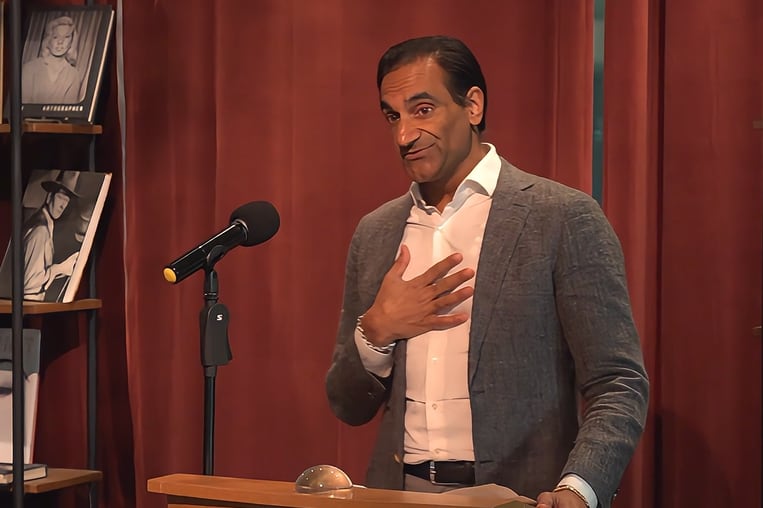
This story was part of Healthbeat’s live storytelling event, “Aha Moments in Public Health,” held Nov. 18 at Powerhouse Arena bookstore in Brooklyn. Watch the full show here. Sign up to receive Healthbeat’s free New York newsletter here.
In July 2015, I stood in front of a packed auditorium in the South Bronx. People were wedged shoulder to shoulder on folding chairs. Another hundred or so crowded the hallway outside, many trying to squeeze in.
I came there to talk about facts. They came there to talk about injustice. That was the night I learned that relationships always come first, and facts come second.
The town hall was organized by the Bronx Borough president to discuss a large outbreak of Legionnaires’ Disease. Legionnaires’ disease is a severe pneumonia caused by bacteria that grow in water. One common source is cooling towers. They sit on rooftops and release a mist that can carry bacteria hundreds of yards through the air. This outbreak had already sickened dozens of people in the South Bronx, and the numbers were rising each day.
I sat in the front of the room. I felt prepared.
I was wearing my favorite suit. Charcoal gray, the J. Crew Ludlow type, similar to the ones our new mayor wears. Sure, it was not the most appropriate choice for a hot summer day. But it was appropriate for my goal that evening: to project credibility, authority, and trust.
I also carried the tools of the public health trade. Maps. Figures. And, most important, the confidence that the best epidemiologists, microbiologists, and environmental health experts in the city had gathered the data, crunched the numbers, and used this to contain the threat. I believed that if I explained the data clearly enough, people would leave reassured.
That is not what happened.
I started the way the Centers for Disease Control and Prevention had trained me. First, describe the disease, its cause, how it spreads, and how it gets treated. Next, describe the investigation. I showed a map of cases and explained that the pattern pointed to something that had been in the air. I told the room that we had identified several contaminated cooling towers, that one of them was the most likely source of the outbreak, and that we had ordered the contaminated towers cleaned.
The air was now safe to breathe.
When I stopped talking, I scanned the room. People’s heads shook from side to side in disagreement. They turned to their neighbors and scowled. Hands shot up. People shouted over one another.
I felt confused. Had I not explained the facts clearly enough? Maybe I should just repeat it with a little different phrasing?
A woman’s voice rose from the back. She spoke sharply and forcefully, and it stopped everyone else from talking, “Why is the outbreak only happening in the Bronx? Why is it always happening here. In our community.”
I felt the power rush out of my suit. It was now constricting me. My palms were sweating, and my black leather shoes were weighing me down.
I had not come prepared to answer that question.
When I get flustered, I don’t stop to think. Or to listen. I just start talking. And then talk some more.
I kept repeating that the air was safe, that the water was safe, that we had fixed the problem. Those were the facts. But the facts weren’t quelling anyone’s anger.
This is the moment that stays with me. That moment when I realized the facts are not enough.
By the time I got to that town hall, I was confident we had found and cleaned the most likely source of the outbreak: a cooling tower on top of a boutique hotel near where we were speaking that night. So, when I said the air was safe, I meant it.
When they heard me say that, they heard something very different.
They heard government saying, “Just calm down. No need to get all worked up.”
They heard a system that had failed to protect them in the past now asking them to trust that this time was different. They heard the long history of neglect that shaped their daily lives well before this outbreak started.
In this community, where chronic disease, environmental pollution, violence, and racism are fixtures of daily life, this outbreak felt like yet another insult. Yet another unfair injury.
Why does this always happen here?
Why is our neighborhood the one that always suffers?
Why should we believe you now?
I came to talk about pathogens and probabilities. They came to talk about fairness and dignity. They wanted to know whether their lives truly counted as much as everyone else’s.
I realized that I had walked into that room thinking my job was to lower fear by explaining risk. What I had not understood, until that night, was that my job was to feel their outrage and connect with them at an emotional level.
The anger in that room was not fundamentally about risks or the facts of the case. It was about the relationship between the city government and this community and their outrage at the way they had been treated in this relationship.
Outrage is shaped as much by history as it is by acute hazards. Communities react to threats based on the stress they already carry, the inequities they already endure, and the ways institutions have treated them long before the first person became sick in this outbreak.
What I learned that night is simple but often overlooked: If you want people to trust you in a crisis, get to know them before the crisis.
As public health officials, we cannot focus only technical excellence. We must focus equally on our relationships with people and communities.
If we wait until an outbreak to learn how people live, what they love, what they fear, and how government has failed them in the past, then we will be speaking past them at the exact moment we need to be speaking with them.
In public health, relationships come first, and facts come second.
Dr. Jay K. Varma is a special contributor to Healthbeat, sharing his expertise from a long career in public health. As a physician and epidemiologist, he is an expert in the prevention and control of infectious diseases who has served as a public health official in New York City.