Public health, explained: Sign up to receive Healthbeat’s free New York City newsletter here.
With New York City and parts of upstate New York under a drought watch, officials are urging residents to limit their use of water.
Following a historically dry October, Mayor Eric Adams and Department of Environmental Protection Commissioner Rohit T. Aggarwala issued a citywide drought watch on Saturday. A drought watch marks the first of three water conservation declarations by the city, which could escalate to a warning or an emergency, depending on conditions in the coming weeks and months.
The New York State Department of Environmental Conservation declared a drought watch for Westchester and the Catskills, in addition to New York City, over the weekend. New Jersey and Connecticut are also facing droughts, and firefighters in both states are battling wildfires.
October saw the the second-longest dry streak in New York City records dating back to 1869. Just 0.01 inches of rain fell in Central Park that month, compared to the 4.4 inches that are typical, according to data from the National Weather Service. Additionally, the upstate reservoirs that supply water to the city are at lower levels than they should be at this time of year, city officials said.
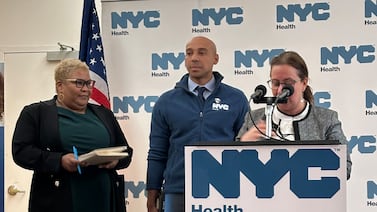
“We’re really urging all New Yorkers to be conscious of water consumption,” Aggarwala said during a press briefing at City Hall on Monday, noting that New Yorkers collectively consume an average of about 1 billion gallons of water per day.
The city transitioned from an unusually wet August to a severely dry autumn, and drier-than-average conditions are expected in the coming months, Aggarwala said. The city faces a nearly six-inch deficit of rainfall — comparing the last 10 weeks to the average rainfall — and its reservoirs are below two-thirds, when they should be at or above three-quarters, he added.
“We need a lot of rain, not just a little,” Aggarwala said.
The drinking water for New York City’s more than 8 million residents comes from a nearly 2,000-square-mile watershed in parts of the Hudson Valley and the Catskills. The city’s public water supply system dates back to the early 19th century, with the creation of a dam and aqueduct that carried water from the Croton River into the city.
Droughts are relatively rare in New York City. The city last experienced a severe drought about two decades ago, when reservoir levels dropped to 44 percent. During that period, the city issued a drought watch in December 2001, followed by a drought warning in January 2002 and the first stage of a drought emergency that April. The 14-month drought ended in January 2003.
The current drought warning is a preparatory measure, Aggarwala said. The city is likely weeks away from issuing a drought warning, he added, during which time city agencies would start to reduce their own water use and urge public water conservation, in order to delay the mandatory restrictions necessary under a drought emergency.
Every city agency has protocols for reducing water consumption, Emergency Management Commissioner Zach Iscol said during Monday’s briefing.
During a drought watch, the city surveys hydrants and conducts leak detection and repair programs. If the city issues a drought warning, city agencies will start limiting water use, including reducing the washing of city vehicles and restricting lawn watering.
If the city declares a drought emergency, public water shortage rules are enforced with sanctions and fines. Pools are closed, athletic fields and golf courses cannot be watered, fountains and aesthetic water displays are prohibited, restaurants cannot serve water unless requested, and other limitations are in place.
For the time being, Aggarwala urged New Yorkers to call 311 to report leaking fire hydrants. He also advised city residents to shorten their showers by a few minutes — one minute in the shower uses about 5 to 7 gallons of water — and to run a fully loaded dishwasher, rather than washing dishes by hand. Aggarwala also urged residents to turn off the tap when using the sink, fix running toilets, and flush toilets less frequently.
“It will save you money on your water bill,” he said. “It will also save the city the water that we need.”
Eliza Fawcett is a reporter covering public health in New York City for Healthbeat. Contact Eliza at efawcett@healthbeat.org .