Public health, explained: Sign up to receive Healthbeat’s free national newsletter here.
In South Carolina’s surging measles outbreak, infectious people have exposed others to the virus in the labor and delivery unit of a hospital – where babies are at high risk of infection, as well as in the workplaces of some of the region’s major employers, including manufacturing plants for BMW and Michelin.
Internal records obtained by Healthbeat from the South Carolina Department of Public Health’s outbreak response reveal more about the scope of the outbreak’s impact within the state and across the country than has been previously made public.
The documents, obtained under South Carolina’s public records law, also show the state’s outbreak has resulted in measles exposure incidents in public locations in several other states. They include infectious people from South Carolina who attended a large youth conference in Kentucky, went to a hospital in Florida, and visited busy travel convenience stores in Georgia and Texas.
Within South Carolina, the department’s internal outbreak reports, as well as emails updating the state’s governor’s office, reveal numerous measles exposure events inside health care facilities. Many have involved urgent care clinics. Others have occurred when infectious people exposed others to the virus at hospitals and pediatrics practices.
The reports note the challenges state health department officials have faced trying to stop one of the largest measles outbreaks in decades, including making sure those in quarantine understand they need to stay at home and away from others, and dealing with some schools that have been slow to cooperate with outbreak investigations. The records reveal the department issued a final notice last month to a private Christian school, warning that it was about to face enforcement action for failing to fully share information about exposed students.
After initially growing slowly since the outbreak was identified on Oct. 2 with just five cases, the number of measles cases exploded in January, nearing 850 confirmed infections by the end of the month. For now, the outbreak is mostly in and near Spartanburg County, in the northwest part of South Carolina, where it’s being fueled by clusters of unvaccinated children and adults.
South Carolina travelers expose people in other states
While health officials in Washington state, North Carolina, and California have announced recent measles cases in their states that are linked to the South Carolina outbreak, the documents obtained by Healthbeat list additional states and locations where infectious people who are part of the outbreak have traveled.
According to the South Carolina DPH’s internal briefing reports for its director, there were exposure incidents during December and January involving contagious South Carolina residents who traveled to Kentucky, where exposures occurred at a “Large NYE Youth Conference” and also at a Hyatt Place hotel; in Georgia at a Love’s travel center; in Texas at a Buc-ee’s travel center; and in Florida at an Embassy Suites hotel.
In addition, there was a potential public exposure at a hospital in Florida, according to a Dec. 29 email from the South Carolina health department to the South Carolina’s governor’s office. The email did not include the hospital’s name or location.
The other reports released to Healthbeat provide little information about the circumstances of the public exposure sites or whether anyone became infected. In most cases, the reports only list the names of sites of public exposures that have occurred in the previous 21 days – which is the maximum period of time it can take for a person to develop symptoms after being exposed to measles.
The South Carolina DPH told Healthbeat its staff was not able to quickly provide more details about the locations listed in the records. Officials with Hyatt, Love’s, Buc-ee’s, and Embassy Suites’ operator Hilton did not answer Healthbeat’s questions about the exposure incidents listed in the reports.
A spokesperson for the Texas Department of State Health Services said it had not been notified of a measles exposure incident at a Buc-ee’s there during this time period. Officials at the Florida Department of Health did not respond to questions from Healthbeat seeking more information about the hospital and Embassy Suites exposures there.
It’s also unclear exactly where or when the “Large NYE Youth Conference” occurred in Kentucky. The South Carolina DPH said it doesn’t have specific details of the event. Officials at the Kentucky Department for Public Health did not answer Healthbeat’s questions about the conference or the separate exposure incident at a Hyatt Place hotel, which appears to have resulted in the infection of a Kentucky resident.
Last month, the local health department in Lexington-Fayette County, Kentucky, issued a measles alert saying an “unvaccinated, out-of-state traveler” stayed at the Hyatt Place in Hamburg, Kentucky, from Dec. 31 through Jan. 2, and also visited a Panera in Hamburg on Jan. 1. No mention was made of the South Carolina outbreak.
An unvaccinated Kentucky resident who was exposed to this “out-of-state traveler” later tested positive for the disease, the Kentucky DPH announced on Jan. 15. A department spokesperson did not answer Healthbeat’s questions about whether the Hamburg exposures and measles infection are linked to the South Carolina outbreak.
Exposures include hospitals, a maternity unit, urgent care centers
Within South Carolina, the state health department’s internal outbreak reports reveal more measles exposure locations than just the schools and stores, restaurants, businesses, and others that have been publicly shared in the information released to the public.
South Carolina state epidemiologist Dr. Linda Bell, in emailed comments to Healthbeat, said the state only notifies the public of the locations of measles exposure incidents when the department knows the specific date and time the exposure occurred, and when it cannot notify all those who have been directly exposed to the infectious person.
In recent weeks, Bell has spoken at media briefings about health care facilities – without naming names – as a place where measles exposures and infections have been occurring.
“We have seen transmission associated with exposures in health care settings,” Bell said during a Jan. 28 briefing. She said the department continues to encourage health care facilities to put masks on people who arrive with symptoms of respiratory illness, which can be early symptoms of measles, and isolate them from waiting areas where other people might be exposed.
Bell said health facilities also should make sure their workers – including administrative and intake staff – are vaccinated. “We are having to track a number of workers across disciplines and health care settings who have been exposed,” Bell said.
State health officials and members of the medical community have been urging that anyone who may have measles call before visiting health facilities, so that arrangements can be made to safely provide assessment and care – such as through a remote telemedicine appointment, an after-hours office visit, or admission to a special hospital isolation unit.
The newly released documents detail the names of hospitals, urgent care clinics, and some practice locations where infectious people have exposed others to measles.
Two of the major health systems serving the South Carolina Upstate region at the center of the outbreak – Spartanburg Regional Healthcare System and Prisma Health – have had multiple incidents where infectious people went into their facilities and exposed others to measles in the December through January period, the state health department’s records show.
One of the listed exposure incidents occurred in the labor and delivery unit at Prisma Health Greer Memorial Hospital, which is located between Spartanburg and Greenville. A spokesperson for Prisma would not answer questions about the incident or whether any infections were associated with it.
Measles is especially dangerous to babies, who are too young to be vaccinated, according to the Centers for Disease Control and Prevention. The virus spreads through the air and infectious particles can remain in a room for two hours after the infected person has left the area.
“Exposure to measles in a labor and delivery unit is highly concerning because measles is extremely contagious and poses serious risks to both pregnant people and those who may not be fully protected against measles,” said Dr. Michael Warren, chief medical and health officer for the March of Dimes, who previously served as the associate administrator of the federal Health Resources and Services Administration’s maternal and child health bureau.
While not commenting on the specific incident in South Carolina, Warren told Healthbeat that the ability of the measles virus to linger in the air for hours increases the likelihood of exposures occurring in that kind of a health care setting. The Birthplace at Greer Memorial Hospital has 10 labor, delivery, recovery and postpartum and recovery rooms, according to a promotional video on its website.
“Labor and delivery units care for multiple patients, with pregnant and postpartum women, newborns, and health care workers in close proximity, so even a single measles exposure can lead to rapid spread if not identified and managed quickly,” Warren said. He added that because newborns and pregnant people can’t receive the measles vaccine, those who are exposed may need special treatment with immunoglobulin, a substance that helps fight infections.
In addition to the exposure incident at Greer Memorial Hospital, other Prisma Health facilities that are listed in the records as sites of public measles exposures include: Greenville Memorial Hospital and its emergency department; Prisma Health Pediatrics in Greer; Prisma Health Urgent Care locations in Boiling Springs and Greenville; and Prisma Pediatrics - Spartanburg.
Prisma Health did not answer questions about whether it is aware of any measles infections occurring in association with exposure incidents in its facilities. In a brief emailed statement, a spokesperson for the system noted that measles is highly contagious and that people can spread the virus before they are diagnosed.
“Prisma Health has taken extensive proactive measures during the measles outbreak to protect patients, visitors, and team members, including visitor restrictions, enhanced masking policies, additional precautions, and broad patient and community education,” the statement said.
Spartanburg Regional Healthcare System also wouldn’t answer questions about the specific exposure incidents inside its facilities and whether any have resulted in infections. Among the system’s facilities noted in the records for exposures: Spartanburg Regional Medical Center, Spartanburg Regional ER, and Pelham Medical Center.
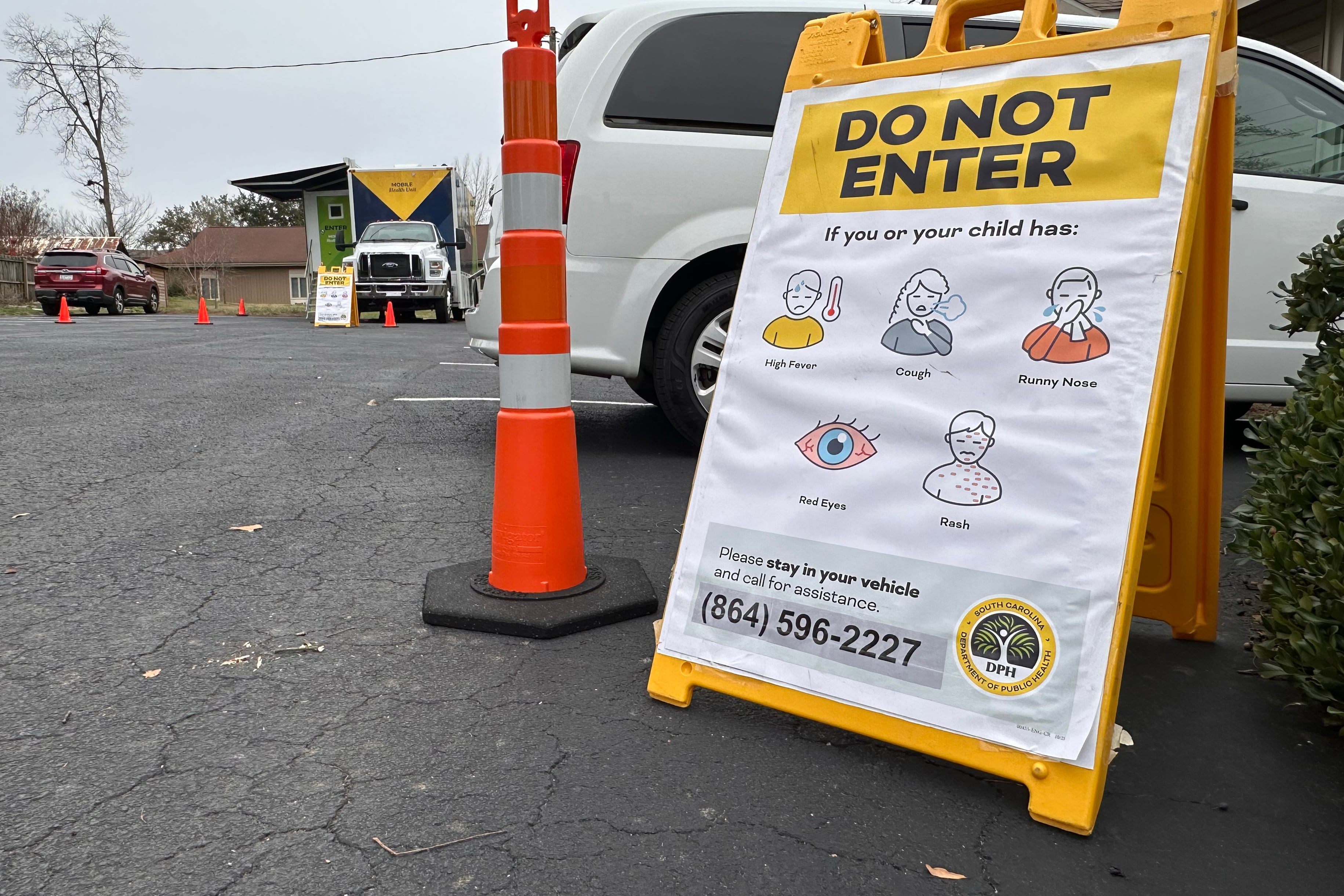
In an emailed statement, the system said it has taken several actions to address the risks of measles exposure in its facilities. They include signs posted at Medical Group of the Carolinas practices to inform patients about the signs and symptoms of measles and instructing them to stay in their vehicles, call the practice’s phone number, and wear a mask. Masks are being required in all of the system’s emergency rooms and immediate care centers. “Associates and providers also are taking airborne precautions – such as wearing masks – when evaluating patients who might have measles,” the system said.
Measles enters BMW, Michelin manufacturing plants
Beyond health care facilities, the documents also show exposures at some major employers in the Spartanburg area that have not been included in the information the state health department has released publicly.
The most prominent of the employers listed in the records are BMW and Michelin.
BMW Manufacturing employs more than 12,000 people at BMW Group Plant Spartanburg, which assembles BMW sports activity vehicles and coupes on what the company describes as its 10 million-square-foot campus. Michelin has had a major tire manufacturing presence in the Spartanburg area for decades.
The state health department flagged the exposures at the BMW and Michelin plants to the state’s governor’s office in a Jan. 12 email with outbreak updates.
In a statement to Healthbeat, BMW said: “The Plant Spartanburg workforce has been informed about the measles cases at the plant. We are following guidance from the South Carolina Department of Public Health and are in regular communication with our teams regarding recommended health protocols.”
The BMW statement said it is providing measles vaccinations onsite and that the company is sharing updates and resources with employees. “We will continue to monitor the situation closely and encourage anyone who is unvaccinated or uncertain about their vaccination status to contact their health care provider promptly,” the company said.
A spokesperson for Michelin declined to answer questions about its exposure and what actions the company is taking in response.
Outbreak investigators face challenges at some schools
Since the South Carolina outbreak began in October, hundreds of students in the Spartanburg area have needed to quarantine at home – and stay out of classes – because they have been exposed to someone who was contagious with measles.
While many schools have helped the state health department’s outbreak investigators identify which students have been exposed and need to be quarantined because they are not fully vaccinated or lack immunity from prior infection, the records obtained by Healthbeat show that others have been slow to provide information.
In one case, the health department got to the point of threatening enforcement action.
Last month, the South Carolina DPH issued a final warning to Westgate Christian School in Spartanburg that it was about to be served with a public health order and face possible penalties because of its failure to comply with an outbreak investigation, according to the records and additional information Bell provided in response to Healthbeat’s questions.
“Being able to identify and notify staff and students who may have been exposed and are at risk for measles is very important to our efforts to limit the spread of measles to the greatest degree possible,” Bell said. “In order to do so, we require lists from the school of those who may be at risk. Schools that don’t provide the full information needed to contact those at risk within 48 hours are considered noncompliant.”
According to Bell, on Dec. 29 the state health department provided a formal, written request to Westgate seeking contact information for students identified as close contacts of a person with measles. The list that the school provided on Dec. 31 was “insufficient,” Bell said.
Bell said the department issued a final notice to the school on Jan. 9, warning that if the requested information wasn’t received by 1 p.m. on Jan. 10, the department “would issue a Public Health Order pursuant to S.C. Code § 44-1-140 compelling compliance.” Under its authority to collect information to address threats to public health, she said the department can take enforcement actions including fines and other legal actions when organizations fail to comply.
Bell said the school provided the required information on Jan. 10, resolving the issue.
Pastor James Wooten, who is listed as the school’s president, told Healthbeat that the school drew the warning because of “some confusion.” The school is a ministry of Westgate Baptist Church. Wooten said that the final notice was unexpected and that the school thought it had provided the health department with the requested information.
Alison Young is Healthbeat’s senior national reporter. You can reach her at ayoung@healthbeat.org or through the messaging app Signal at alisonyoungreports.48