Public health, explained: Sign up to receive Healthbeat’s free national newsletter here.
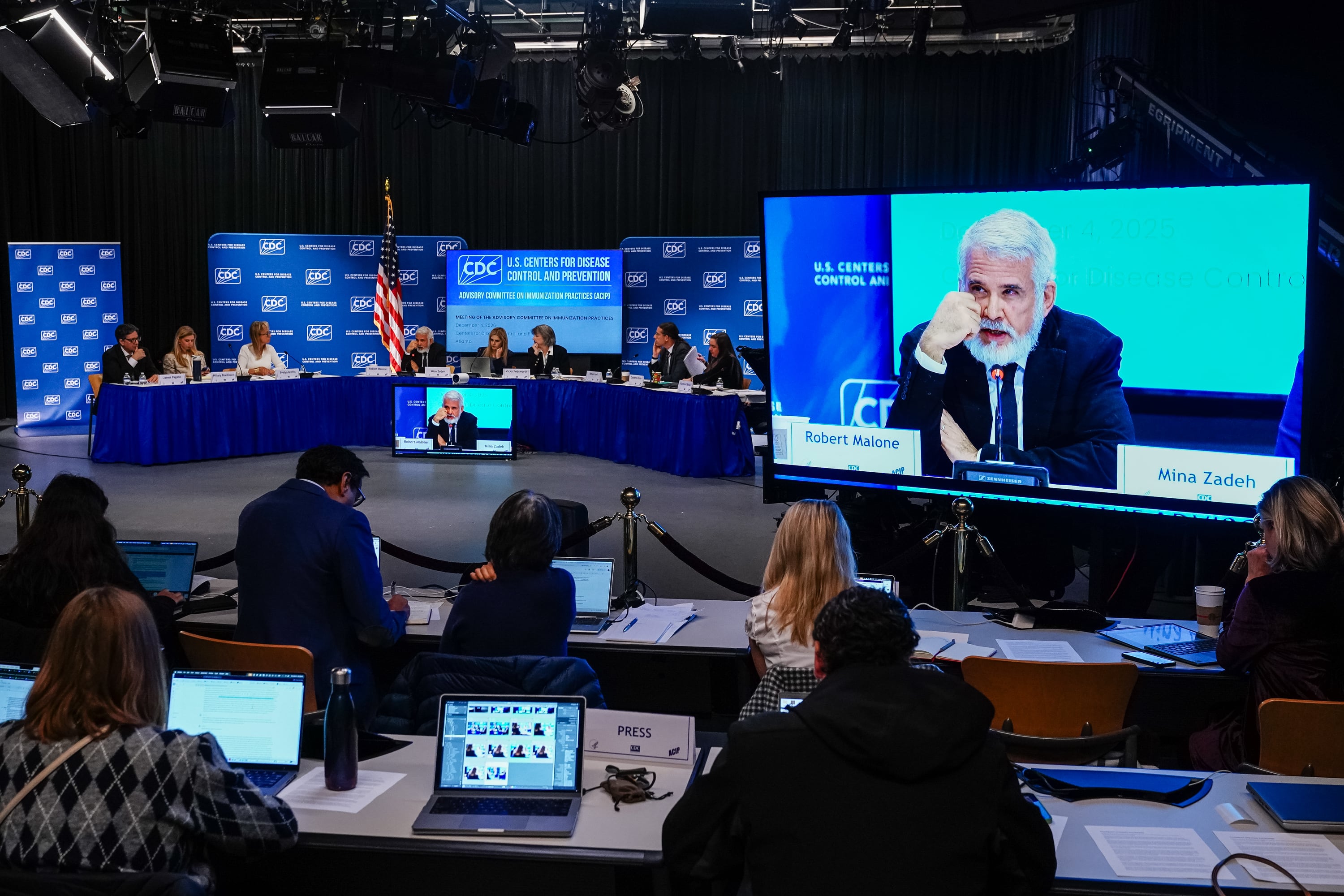
A federal vaccine advisory committee delayed votes Thursday on changes to hepatitis B immunization recommendations for infants as a top Republican senator called the group “totally discredited.”
U.S. Sen. Bill Cassidy, chairman of the Senate Health, Education, Labor, and Pensions Committee, expressed outrage over a scheduled briefing to the Advisory Committee on Immunization Practices on Friday by lawyer and vaccine critic Aaron Siri.
“Aaron Siri is a trial attorney who makes his living suing vaccine manufacturers. He is presenting as if an expert on childhood vaccines. The ACIP is totally discredited. They are not protecting children,” Cassidy, a Louisiana Republican and a physician, said on the social media platform X.
It’s unclear whether Cassidy plans to take any further action. His spokespeople did not immediately respond to questions from Healthbeat.
The committee, based at the Centers for Disease Control and Prevention, has become a flashpoint for controversy since this summer when Health and Human Services Secretary Robert F. Kennedy Jr. dismissed all its members and appointed replacements.
At Thursday’s ACIP meeting, CDC vaccine subject matter experts were largely sequestered in a “SME room” away or remote offices, away from where the committee members meet and providing expert input through video connections only when asked.
Siri, a Kennedy ally, is scheduled to brief the committee Friday morning on the childhood and adolescent immunization schedule, the evolution of the schedule, and a comparison of the U.S. schedule to those in other countries. The meeting’s agenda, as of Thursday, did not disclose any details about his presentation.
Siri, who compared himself to consumer advocates like Ralph Nader, fired back at Cassidy on X, saying vaccine manufacturers regularly speak before the committee. “Yet, I have never heard you take issue with those presenters,” he wrote.
On Thursday, the committee’s focus was on a push by some of its members to reduce the number of infants who are vaccinated at birth against hepatitis B, a serious infection that can cause chronic liver disease and cancer. The committee’s work group was led by ACIP committee member Vicky Pebsworth, research director of the National Vaccine Information Center, a group that warns against vaccine risks.
“It’s been 35 years since the universal birth dose policy was implemented,” she said. The work group was asked to assess whether the universal birth dose should continue to be given to children of mothers who test negative for the virus.
Since the universal birth dose started being given in 1991, there has been a 99% decline in cases of hepatitis B among children, adolescents and young adults.
Pebsworth said the review was prompted to address parent and stakeholder concerns about administering the hepatitis B vaccine at birth.
The committee voted 6-3 to postpone until Friday votes on any changes to the current recommendation that all infants be vaccinated against hepatitis soon after birth.
The decision to delay came after some committee members objected that they had no way to know what they were voting on. While the proposals were verbally read to the committee by vice chairman Robert Malone, they weren’t provided copies of the proposals’ text so they could assess and discuss the language.
The proposals, among other things, would recommend a birth dose of hepatitis B vaccine for babies born to women who test positive for the virus – a significant change from the current recommendation that all babies receive the vaccine. The proposals also contain language that would recommend delaying an initial dose of the vaccine until a child is 2 months old.
Text of the three proposals briefly read during Thursday’s meeting was not posted on the committee’s website.
Edward Tate, a spokesperson for the Hepatitis B Foundation, said Thursday’s meeting was concerning for many reasons.
“The meeting lacked transparency, with many of the presentations showing one-sided data, and several points made by committee members clearly showed that they have a very specific agenda,” he said.
“The committee members dismissed the extensive body of scientific data and real-life experience that prove the necessity, safety and value of the universal birth dose vaccination for hepatitis B,” Tate said.
The committee will resume its meeting at 8 a.m. Eastern on Friday. The meeting will be livestreamed at this link.
Alison Young is Healthbeat’s senior national reporter. You can reach her at ayoung@healthbeat.org or through the messaging app Signal at alisonyoungreports.48